

TL;DR
- In-house SEO teams offer control but come with high fixed costs, slow scalability, and long-term risk.
- Freelancers look affordable upfront but often introduce hidden costs through coordination, inconsistency, and rework.
- White-label SEO provides predictable, scalable pricing with lower operational overhead.
- The real cost difference isn’t hourly rates. It’s elasticity, efficiency, and execution risk.
- For agencies and SMBs, white-label models often deliver higher ROI once growth and scale are factored in.
Introduction
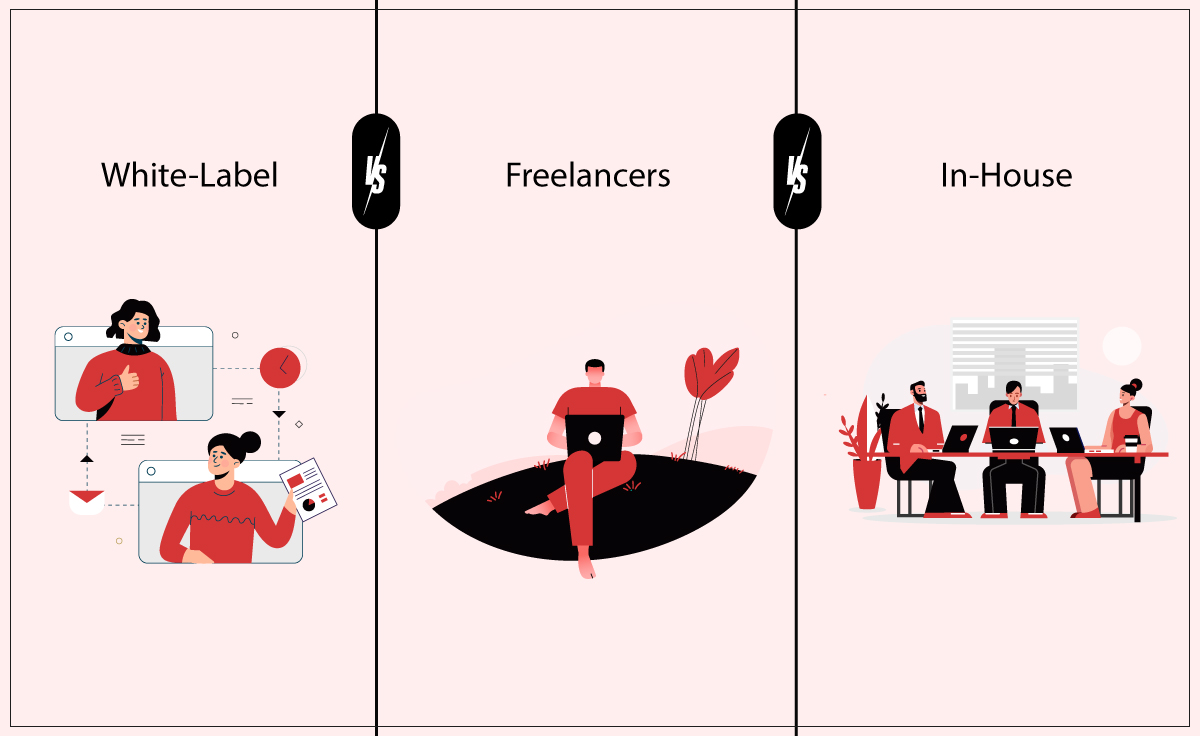
Every growing business eventually faces the same decision: Should we build an in-house SEO team, rely on freelancers, or partner with a white-label provider?
On the surface, this looks like a simple cost comparison. In reality, it’s a structural decision that affects margins, delivery speed, and long-term scalability. Many teams underestimate the true cost because they compare invoices, not systems.
Most blogs oversimplify this choice:
- In-house = control
- Freelancers = flexibility
- White-label = scale
That framing misses the real issue.
Cost isn’t just what you pay. It’s what the model forces you to absorb.
Hidden overhead, management time, delivery risk, and opportunity cost are where decisions quietly go wrong.
This article breaks down the real financial, operational, and strategic cost of each model (using realistic benchmarks, not marketing promises) so you can choose what actually supports growth.
Why Choosing Between White-Label, Freelancers and In-House Is So Hard
The confusion usually comes from comparing the wrong things.
Most teams evaluate:
- Hourly rates
- Monthly retainers
- Headcount costs
But experienced operators look at:
- Cost elasticity under scale (As work increases, does the cost blow up or stay efficient?)
- Management and coordination overhead (How much time do you spend managing, aligning, fixing, and chasing?)
- Risk of delivery failure (What’s the chance the work is late, wrong, or never delivered?)
- Time-to-output (How fast do you actually get usable results?)
- ROI consistency over 12–24 months (Does this option reliably produce value long-term, not just look cheap now?)
Without this lens, even “cheap” options become expensive over time.
The Baseline: What “Cost” Really Means (Beyond Salaries & Invoices)
Before comparing models, we need to align on what “cost” includes in the real world:
- Direct spend (salary, retainer, hourly fees)
- Benefits, payroll tax, and compliance
- Recruitment and churn
- Software and tooling
- Management and coordination time
- Scalability friction (how fast cost rises with demand)
- Risk exposure (missed deadlines, inconsistent output, rework)
Most comparisons ignore at least half of this.
That’s why they’re misleading.
Cost Comparison: White-Label vs Freelancers vs In-House
Let’s break down the cost model by model.
Cost Breakdown for In-House Teams: Predictable Control, Unpredictable Expense
In-house feels “safe” but it’s the most capital-intensive option.
Typical US salary ranges
This is what everyone accounts for:
- SEO specialist: $60,000–$80,000
- Content writer: $55,000–$75,000
- Marketing manager: $75,000–$110,000
- Designer: $55,000–$75,000
A minimal in-house marketing setup (even without paid media) easily crosses $250,000–$400,000/year in salaries alone.
Additional costs
Now add what doesn’t show up on offer letters:
- Benefits & insurance: 20–30% of salary
- SEO tools: $500–$2,000/month
- Hiring cost per role: $4,000–$5,000
- Continuous training and certifications
Reality check:
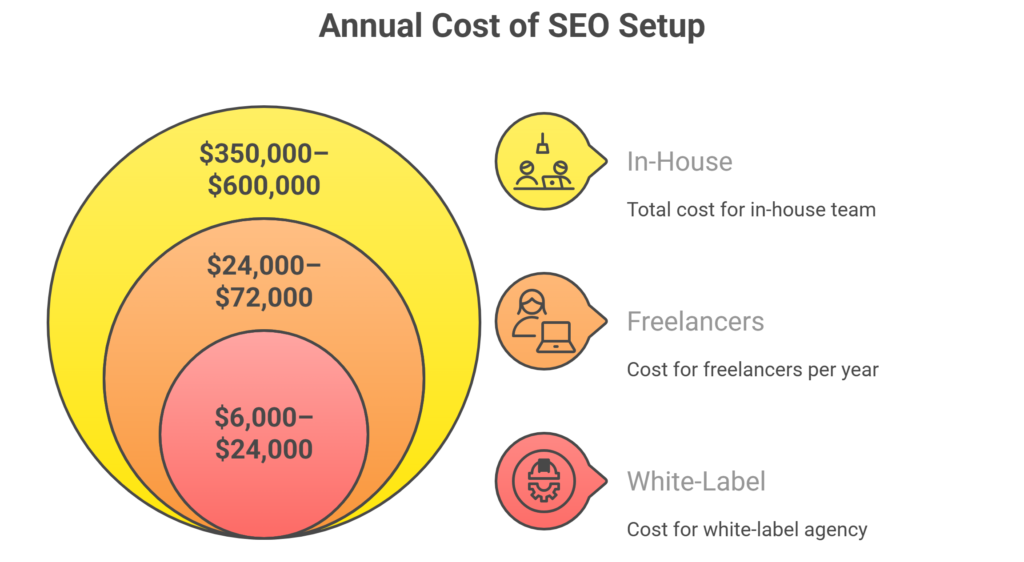
A lean in-house SEO setup often costs $350,000–$600,000 annually before output stabilizes.
The real constraint: elasticity
In-house teams don’t scale smoothly.
Demand spikes? You burn out people or delay delivery.
Demand drops? You still pay fixed costs.
That rigidity is the real tax.
Read More: The Hidden $180K Cost of In-House SEO
Cost Breakdown for Freelancers: Flexible on Paper, Fragmented in Practice
Freelancers are attractive early on. Lower commitment. Faster onboarding. Seemingly cheaper.
But these appear cost-effective until you aggregate reality.
Typical rates
- Writers: $30–$100/hour
- SEO specialists: $50–$150/hour
- Designers: $40–$120/hour
At 40–60 hours per month, even one freelancer can cost $2,000–$6,000 monthly. Multiply that across SEO, content, links, and design. The costs stack fast.
Hidden costs
- Time spent briefing and re-briefing
- Quality inconsistency
- Revisions and rework
- Missed deadlines
- Freelancer churn mid-project
Risk factor
Freelancers optimize for their workload, not your delivery system. That misalignment shows up over time.
Coordination lands on founders, account managers, and senior marketers. This is management cost, not just execution cost. And it’s rarely tracked.
Cost Breakdown for White-Label SEO Agencies: Variable Pricing, Structural Leverage
This is where many growing agencies eventually land, often after getting burned once.
White-label SEO pricing is typically structured around monthly retainers per client or per scope, not hours.
Typical costs
- Monthly retainers: $500–$2,000 per client, depending on scope and depth
- Add-ons: advanced content, link building, local SEO, or technical audits
Why pricing stays predictable
- Fixed deliverables
- Defined Service Level Agreements (SLAs)
- Standardized processes
- Built-in quality assurance (QA) and reporting
Scalability advantage
- Costs rise only when revenue rises
- No hiring delays
- No bench cost during slow months
Key insight:
White-label SEO converts marketing delivery from a fixed cost into a variable cost, which is why agencies favor it as they scale.
White-label models bundle execution teams, process maturity, QA layers, tooling, and delivery management. You’re not paying for hours. You’re paying for outcomes at scale. That shifts cost from fixed to elastic.
The Overlooked Advantage of White-Label SEO: Margin Predictability
For agencies and small teams, white-label partnerships:
- Protect margins during growth
- Reduce hiring risk
- Absorb volume spikes without chaos
This is why many mature agencies run hybrid models:
- Strategy and client relationships in-house
- Execution via white-label partners
Which Model Delivers Better Value? ROI Comparison
ROI isn’t about spend. It’s about output relative to effort and risk.
- In-house teams deliver ROI slowly but steadily if retention is high.
- Freelancers can deliver spikes of ROI but rarely consistency.
- White-label SEO often delivers faster time-to-impact due to mature processes and specialization.
Industry outsourcing studies consistently show outsourced and white-label models outperform in-house teams on ROI when scale and specialization are required.
White-label digital marketing can be up to 40–60% cheaper than building an in-house team. It also usually provides 50–70% higher profits.
Time & Resource Efficiency Comparison
Time is an invisible cost most teams ignore.
- In-house: Slow to hire, slower to pivot
- Freelancers: Fast to start, slow to coordinate
- White-label: Fast to deploy, fast to scale
For agencies managing multiple clients, execution speed directly impacts client retention and upsell potential.
Quality & Expertise Comparison
Quality depends on systems, not individuals.
- In-house quality depends on who you can hire and retain
- Freelancer quality varies per task and availability
- White-label quality improves through:
- Standard operating procedures
- Multi-layer QA
- Specialized roles instead of generalists
This is why mature agencies prioritize process maturity over talent heroics.
Hidden Costs that Businesses Ignore
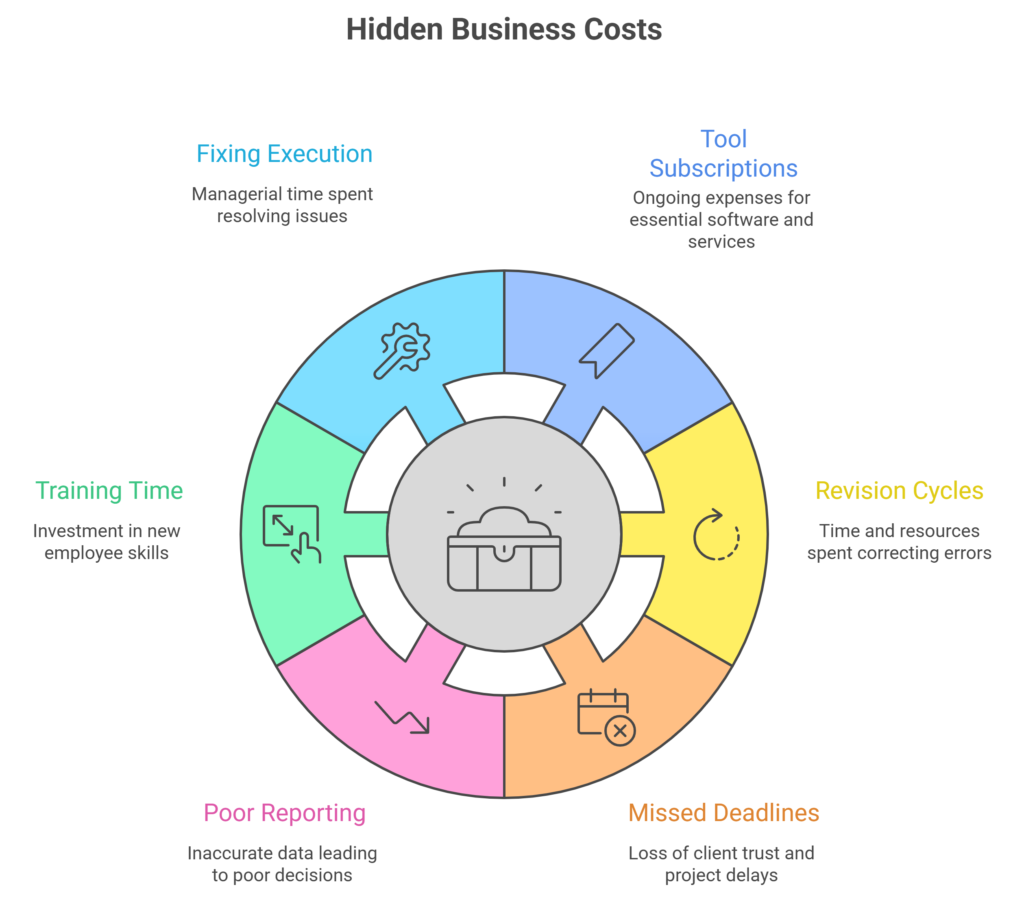
These don’t show up on proposals but they hit margins hard:
- Tool subscriptions (SEO, reporting, content)
- Revision cycles due to misalignment
- Missed deadlines impacting client trust
- Poor or inconsistent reporting
- Training time for new hires or replacements
- Founder or manager time spent “fixing execution”
Pro tip: If execution requires constant supervision, it’s already costing more than it looks.
When White-Label SEO Makes the Most Sense
White-label SEO is most effective when:
- You sell SEO or content as a recurring service
- Your client volume fluctuates
- You want predictable margins
- You don’t want delivery risk to scale with growth
- Strategy and relationships stay in-house, execution doesn’t
This is why many agencies quietly adopt hybrid models: strategy inside, execution white-labeled.
Realistic Cost Comparison Table (White-Label vs. Freelancers vs. In-House)
| Factor | White-Label SEO | Freelancers | In-House |
| Cost | $6k–$24k per year (per client) | $24k–$72k per year (fragmented) | $350k–$600k+ per year |
| Expertise | High | Medium | Varies |
| Speed | Fast | Medium | Slow |
| Scalability | High | Low | Medium |
| Risk | Low | Medium | High |
| Best For | Agencies, SMBs | Very small teams | Enterprise |
Conclusion
Choosing between white-label, freelancers, and in-house SEO isn’t about picking the cheapest option. It’s about choosing the model that absorbs complexity instead of amplifying it. For teams focused on growth, predictability, and margins, white-label SEO often provides the most balanced path forward without locking you into fixed costs that slow momentum.
Schedule a free strategy call with our team, and we’ll show you whether white-label services are for you based on your specific client volume, service offerings, and growth goals. You’ll see exactly how much you could save and how fast you could scale.
FAQs
What is the real cost difference between white-label, freelancers, and in-house SEO?
White-label shifts cost from fixed to variable, freelancers introduce coordination risk, and in-house carries the highest long-term overhead.
Is white-label SEO cheaper than hiring a full-time team?
In most cases, yes, white-label SEO is cheaper. Especially when benefits, tools, and hiring costs are included.
Are freelancers reliable for long-term SEO projects?
They can be, but consistency and availability are common challenges at scale.
Is in-house SEO worth the investment for small businesses?
In-house SEO is worth it only when SEO is a core internal function, and budgets allow long-term investment.
What hidden costs come with freelancers or in-house teams?
Revisions, delays, management time, tool subscriptions, and training are the common hidden costs that come with freelancers or in-house teams.
What are the advantages of white-label SEO agencies?
Predictable pricing, scalability, mature processes, and reduced execution risk are some of the biggest advantages of working with white-label SEO agencies.
Which model offers the best ROI in 2026?
For growing agencies and SMBs, the white-label model consistently outperforms on ROI.