


TL;DR
- A white-label partnership succeeds or struggles largely based on how well the first 90 days are handled.
- A clear white-label integration playbook helps agencies align workflows, communication, and responsibilities before live delivery begins.
- The first 30 days focus on onboarding and platform alignment so the partner fits into existing tools, processes, and delivery expectations.
- Days 31 to 60 act as a pilot phase, where agencies test real client work on a small scale to validate timelines, quality, and review cycles.
- Days 61 to 90 focus on scaling delivery gradually, adding more accounts and services without changing the established workflow.
- Choosing the right white-label provider depends on process clarity, consistency, flexibility, and experience with agency workflows.
- A well-integrated white-label setup allows agencies to grow capacity, protect margins, and maintain a consistent client experience over time.
Introduction
Scaling an agency often means balancing growth with delivery capacity. As client needs expand, many teams turn to white-label partnerships to keep up without stretching internal resources. What usually makes the difference is not the decision to outsource, but how well the integration is handled. A White-label integration plays a key role in shaping whether the partnership feels seamless or operationally heavy.
This blog walks through a practical 90-day approach to white-label integration, covering onboarding, pilot execution, and scaling. It is designed to help agencies set up processes that support consistent delivery, clear communication, and steady growth without disrupting existing workflows.
What Is a White-Label Integration Playbook and Why It Matters
A white-label integration playbook is simply a clear way to understand how a White-label integration platform will work with your agency once you start. It lays out how work moves between teams, how communication happens, and how delivery stays consistent as things pick up pace.
If you’re exploring white-label partnerships, this playbook helps set expectations early. Instead of figuring things out on the fly, both sides know how collaboration will work and what the day-to-day looks like.
In practical terms, a good playbook helps clarify:
- How work moves between your team and the partner
- How communication and reporting stay consistent
- How responsibilities are divided without overlap
- How the partnership supports long-term service delivery
This structure is especially helpful for agencies offering ongoing services like SEO or content. When integration is planned upfront, the white-label setup feels like a natural extension of your agency rather than an external add-on.
A solid playbook keeps collaboration smooth, supports steady delivery, and makes it easier to scale services with confidence.
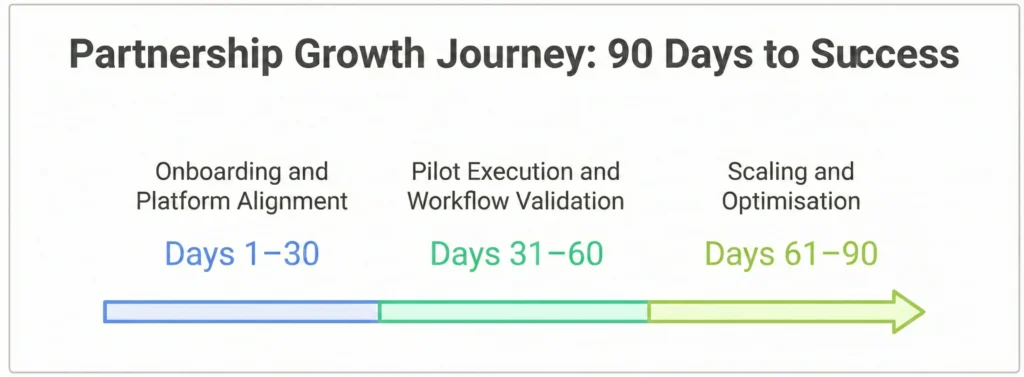
Phase 1 (Days 1–30): Onboarding and Platform Alignment
The first 30 days are about setting things up the right way. This phase focuses on alignment rather than output, so that once work begins, delivery feels smooth and predictable.
At this stage, the goal is to understand how the partnership will work in practice. A White-label integration platform should fit into your existing workflows, tools, and communication style, instead of forcing your team to adapt to an entirely new process.
During onboarding, agencies typically focus on a few core areas:
- Workflow alignment: Both teams agree on how work moves from briefing to delivery, including timelines, approvals, and revision cycles, so there is clarity before live client work starts.
- Tool and communication setup: The partner is added to your existing project management and communication tools, keeping collaboration simple and familiar for your team.
- Brand and delivery guidelines: Brand references, tone expectations, and reporting formats are shared early, helping ensure consistency in all client-facing output.
- Kick-off alignment: A structured kick-off conversation confirms goals, responsibilities, and points of contact, so execution stays organised from the start.
By the end of the first 30 days, the partnership should feel settled. Both sides understand how work flows, which makes it easier to test delivery and scale confidently in the next phase.
Phase 2 (Days 31–60): Pilot Execution and Workflow Validation
Days 31 to 60 are about working with real client data and real delivery timelines. By this point, onboarding is complete and the collaboration has settled into a routine. This phase helps confirm whether the setup holds up once live work begins.
Most agencies start small here. A limited number of accounts allows teams to observe how briefs are interpreted, how turnaround times feel, and how closely the output aligns with internal standards. This is especially important for services that run on a monthly cadence, such as white-label SEO retainers, where consistency matters more than speed.
During this phase, agencies typically focus on:
- Pilot account selection: A small group of stable accounts is chosen so workflows can be tested without pressure from complex or high-risk clients.
- Delivery and review cycles: Content and reports move through the full review process, helping teams understand where approvals take time and where clarity can be improved.
- Output calibration: Early feedback is used to fine-tune execution, whether that involves reporting formats, content depth, or collaboration around White Label Content Creation.
By the end of days 31 to 60, agencies usually have a clear sense of how delivery performs under real conditions. The focus is confidence. Teams know what to expect, how long work takes, and how quality holds up, which makes the transition to higher volumes smoother in the next phase.
Phase 3 (Days 61–90): Scaling and Optimisation
By the time you reach days 61 to 90, the working relationship should feel familiar. Everyone knows how tasks move, how long things take, and what finished work is expected to look like. This phase is about extending that same setup to more client work without changing how the process runs.
Most agencies start bringing in additional accounts at this point. The idea is to increase volume gradually, using the same structure that has already been tested. This helps keep delivery steady while account managers continue working the way they are used to.
During this phase, agencies often focus on a few practical areas:
- Adding more accounts: New client work is introduced in small batches, so the workflow stays manageable and predictable.
- Expanding service coverage: Once the main delivery feels stable, agencies may add related services, such as link building or local execution, without altering the client-facing setup.
- Reviewing performance: Timelines, output quality, and overall efficiency are reviewed to understand what is working well and where small improvements can be made.
By the end of the first 90 days, the partnership should feel routine rather than new. Work moves through a clear process, expectations are shared, and scaling delivery no longer requires constant adjustments. This makes it easier to plan growth with confidence.
Read More: Why You Should Outsource Your Local SEO
In-House vs. White-Label Partner: A Strategic Comparison
As agencies grow, delivery decisions start affecting timelines, costs, and team capacity. Choosing between building everything in-house or working with a partner often depends on how quickly you need to scale and how much operational complexity you are willing to manage.
Both models can work well when applied in the right context. The comparison below highlights how they typically differ in day-to-day operations.
| Area | In-house team | White-label partner |
| Team setup | Requires hiring, onboarding, and ongoing training | Uses an existing delivery team |
| Cost structure | Fixed salaries and overhead | Variable costs based on active work |
| Speed to scale | Limited by internal capacity | Supports faster expansion |
| Process maturity | Built gradually over time | Comes with established workflows |
| Management effort | Requires daily oversight | Runs with defined coordination |
| Service flexibility | Depends on internal skill sets | Easier to extend into new services |
For many agencies, the choice is not about replacing internal teams. It is about finding the right balance between strategy and execution. A white-label partner often supports delivery-heavy work, while internal teams stay focused on planning, client communication, and growth.
Key Features to Look for in White Label Providers
Once you reach the stage of choosing a partner, the details start to matter more than the pitch. A good white label setup should make your work easier, not add another layer to manage.
When evaluating white label providers, it helps to look beyond service lists and focus on how they actually work with agencies day to day.
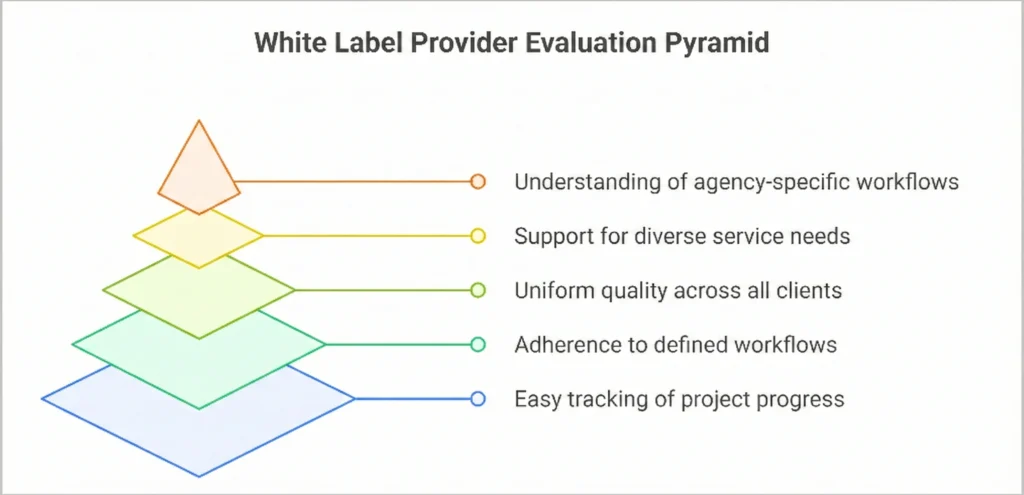
Some features that tend to make a real difference include:
- Clear visibility into delivery: You should be able to see what is in progress, what is completed, and what needs input, without chasing updates or piecing information together.
- Strong process discipline: Partners who follow defined workflows are easier to work with over time, especially when volumes increase and multiple accounts are involved.
- Consistency across accounts: Output should follow the same standards regardless of client size or service type, so quality does not fluctuate as work scales.
- Flexibility in execution: A good White Label Platform supports different service needs without forcing you into rigid formats or timelines that do not match your agency’s model.
- Experience with agency workflows: Partners who regularly work behind the scenes understand the importance of brand alignment, timelines, and quiet execution.
Choosing the right provider often comes down to fit. The strongest partnerships are the ones where delivery feels steady, communication feels natural, and the white label setup blends into how your agency already operates.
Conclusion
A strong white-label setup is built in the early months. The first 90 days determine how naturally delivery fits into existing workflows and how confidently services can scale over time. When integration is approached in clear stages, teams gain clarity without slowing down daily operations.
Justwords is designed to integrate into agency processes without adding friction. With over 15 years of experience, Justwords has developed repeatable systems for content and SEO that support organic growth and client outcomes across industries like finance, tech, healthcare, and ecommerce. Delivery aligns with your tools, timelines, and expectations, allowing work to move forward without constant coordination. This gives your team the space to focus on client relationships and growth. If you are exploring a white-label partnership and want to understand how this approach could support your agency, contact us today to learn more.
FAQs
How do agencies transition clients without disruption?
Clients typically do not see any change. Delivery shifts internally while account management, communication, and reporting remain the same, which helps maintain trust and continuity.
What internal roles are still needed after white-label integration?
Agencies still need roles focused on strategy, quality review, and client communication. White-label partners support execution, not relationship management or high-level planning.
How flexible are white-label agreements over time?
Most partnerships allow agencies to adjust volume, services, or scope as needs change. This flexibility supports growth without long-term staffing commitments.
Does white-label integration limit service customization?
No. Customisation remains possible when briefs and expectations are clearly defined. White-label delivery works best when flexibility is balanced with repeatable processes.
How do agencies measure long-term success beyond delivery speed?
Long-term success is usually measured through client retention, consistent output quality, predictable costs, and the ability to scale services without increasing operational strain.