


TL:DR
- Healthcare SEO requires compliance. HIPAA violations bring heavy fines, and ignoring YMYL standards can destroy rankings.
- Generic SEO creates risk. Mishandled testimonials, outdated medical content, and missing BAAs expose clients to liability.
- Healthcare SEO is specialized. It requires a medical schema, physician credentials, healthcare directories, and stronger security.
- White-label providers solve the gap. They provide compliant systems and medical content expertise that agencies lack.
- The advantage: speed and protection. Agencies can offer healthcare SEO without building costly in-house expertise.
Introduction
Google holds healthcare websites to a standard that most agency owners don’t know exists. Patient testimonials require HIPAA-compliant consent forms. Clinical content needs licensed physician review. Google’s YMYL standards scrutinize medical accuracy with unprecedented strictness. One misstep (a patient photo without consent, outdated treatment information, or missing security protocols) and you’re facing $50,000 fines and immediate client termination.
Many have heard the words “HIPAA” and “YMYL” thrown around in client calls, but few have taken time to understand what they actually mean for a medical practice or actively worked to make their services compliant.
Today, we’ll find out how getting healthcare SEO right does two very important things at once.
Most of the effort in SEO goes toward either protecting your client from penalties or improving their rankings. The beauty of doing healthcare SEO properly is that it actually does both. You protect the client, and you grow their traffic.
Why Generic SEO Is Dangerous for Healthcare Clients
To understand what’s at stake, you have to understand two things – one from Google, one from the federal government – that fundamentally change the rules.
The YMYL Reality
What is YMYL? Your Money Your Life – Google’s designation for content that affects someone’s health, finances, or safety. Healthcare websites sit at the very top of this list. The content requirements are unlike anything you’d face for a hospitality or e-commerce client.
For a medical website to satisfy YMYL:
- Content needs to be written or reviewed by a licensed medical professional.
- Content needs citations to peer-reviewed journals, the CDC, the WHO, or recognized medical associations.
- Author credentials (MD, DO, RN, their specializations) need to be prominently displayed.
- Content needs to be updated when medical guidelines change.
- Pages need to carry a clear disclaimer that nothing on the site substitutes for professional diagnosis.
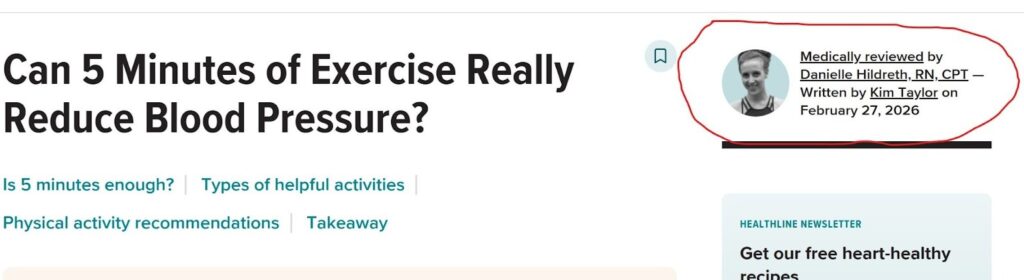
Without those things, what happens? Organic traffic drops significantly within three to six months. Medical content gets filtered out of AI Overviews and featured snippets entirely. Pages end up buried past position 20 regardless of how strong the backlink profile is. And recovery, once you’re in that hole, requires six to twelve months of documented content overhaul with physician sign-off.
But why do generic SEO agencies end up here? They use AI content without medical review, cite unreliable sources, lack physician partnerships for content validation, and don’t understand current medical guideline requirements. None of this is malicious; it’s just the wrong toolkit for the job.
The HIPAA Minefield
What is HIPAA? The Health Insurance Portability and Accountability Act – federal law protecting the privacy of patient health information.
Most agencies know the word. Very few understand where it actually intersects with SEO work, and that’s where the real danger is.
Here’s where generic SEO creates HIPAA violations without realizing:
- Patient testimonials: You can’t publish a patient’s name, photo, or specific health condition without written HIPAA-compliant authorization. Not a generic release form, a HIPAA-specific one. Agencies pull testimonials from the clinic without this documentation all the time. The penalty: $100–$50,000 per violation.
- Before/after photos: These require a signed photo release and a HIPAA-compliant authorization for marketing use. A standard consent form isn’t sufficient. Penalty: $100–$50,000 per photo, plus potential civil lawsuit.
- Contact forms and live chat: You can’t collect health information through a standard contact form. It needs to be encrypted and HIPAA-compliant. The kind of form that ships with most website templates isn’t. Penalty: $100–$50,000 per breach.
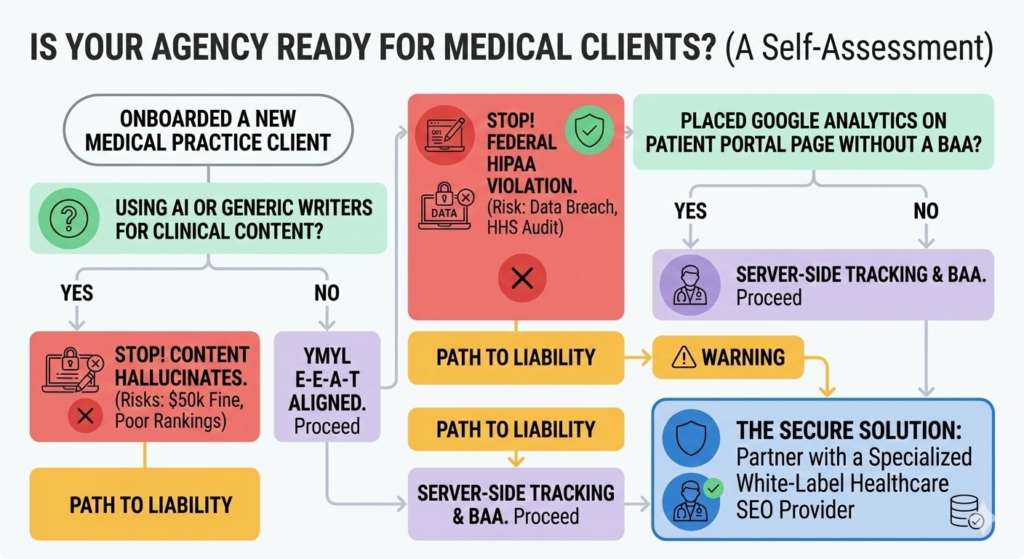
- Analytics and tracking: Installing Google Analytics on a patient portal without a Business Associate Agreement (BAA) in place with Google violates HIPAA. Most agencies have never heard of a BAA, let alone arranged one. Penalty: $100–$50,000 per violation.
- Email marketing: Appointment reminders and health tips require HIPAA-compliant email platforms. Standard Mailchimp, without a BAA, doesn’t qualify. Penalty: $100–$50,000 per non-compliant communication.
The cost of not knowing any of this is: one healthcare client with 10 HIPAA violations is a $1,000–$500,000 liability. And your agency is on the hook if you implemented the non-compliant systems.
The Compliance Traps That Destroy Agencies
A lot of the damage we’ve seen comes not from deliberate shortcuts but from agencies applying standard operating procedures to a context where the standard doesn’t work.
The Data Privacy Trap
Generic agency onboards a medical practice. Installs Facebook Pixel, Google Analytics, and a heatmap tool. Completely normal onboarding.
The problem: those tools track patient behavior on pages containing Protected Health Information (PHI). Transmitting PHI to Facebook and Google without BAAs in place is a HIPAA violation. The client gets a Department of Health and Human Services (HHS) audit notification. The agency has no BAAs. The client faces $50,000–$1.5 million in fines. The agency loses the client, faces a lawsuit, and gets quietly blacklisted across the healthcare industry.
The fix isn’t complicated, but you have to know it exists. Specialized providers maintain BAAs with every vendor, use HIPAA-compliant analytics platforms, and implement tracking setups that don’t transmit PHI.
During a compliance audit we conducted for a mid-sized dermatology clinic in Minnesota, a routine SEO review uncovered that a Facebook Pixel had been installed on a patient intake form page. Because the form collected treatment information, the tracking script was transmitting PHI to a third party without a BAA in place.
We resolved the issue by removing tracking from PHI-related pages and implementing a HIPAA-compliant analytics setup that allowed performance monitoring without transmitting patient data.
This type of issue is surprisingly common when standard marketing tracking tools are applied to healthcare websites without HIPAA-aware configuration.
The Review Solicitation Trap
The agency tries to boost a client’s reputation by asking patients for reviews. Again, completely normal practice.
In healthcare, it’s regulated. You can’t incentivize reviews (discounts or gifts violate FTC guidelines). You can’t selectively ask only satisfied patients (that’s a deceptive practice). You can’t edit or suppress negative reviews outside of clear policy violations. You need compliant review collection systems.
One misstep here and you’re looking at a medical board investigation, a Federal Trade Commission (FTC) complaint, and a client whose license is now in question.
The AI Content Trap
We’ve tested this ourselves. AI writing tools hallucinate medical statistics. They cite outdated treatment protocols. They miss contraindications entirely. They invent success rate figures that sound plausible but aren’t.
Published on a medical practice’s website, this content fails Google’s E-E-A-T evaluation, and if a patient actually follows it, the consequences go well beyond rankings. Medical malpractice lawsuits have named agencies. Google’s YMYL penalty buries the site. The practice faces medical board scrutiny.
The fix: every piece of clinical content reviewed by a licensed physician, citations pulled from current peer-reviewed literature, and a documented review process that proves it.
Technical Healthcare SEO: Beyond Basic Optimization
Technical SEO for a medical practice goes well beyond page speed and canonical tags. There’s an entire layer of medical-specific implementation that generic agencies simply don’t know about.
Medical Schema Markup
Most agencies, if they add schema to a healthcare client’s site, use a standard LocalBusiness type. That’s not sufficient.
Healthcare websites need Medical Organization or Physician schema, with fields that include medical specialties, accepted insurance networks, available procedures, and physician credentials, including medical school, residency, and professional memberships.
This is what signals legitimacy to Google’s healthcare algorithms, enables rich snippets showing insurance and credential information, and gets a practice cited in AI Overviews. A generic LocalBusiness schema doesn’t do any of that.
Security and Trust Protocols
This is where HIPAA and technical SEO overlap. Healthcare websites need HIPAA-compliant hosting servers configured to meet HIPAA’s physical and technical safeguard requirements.
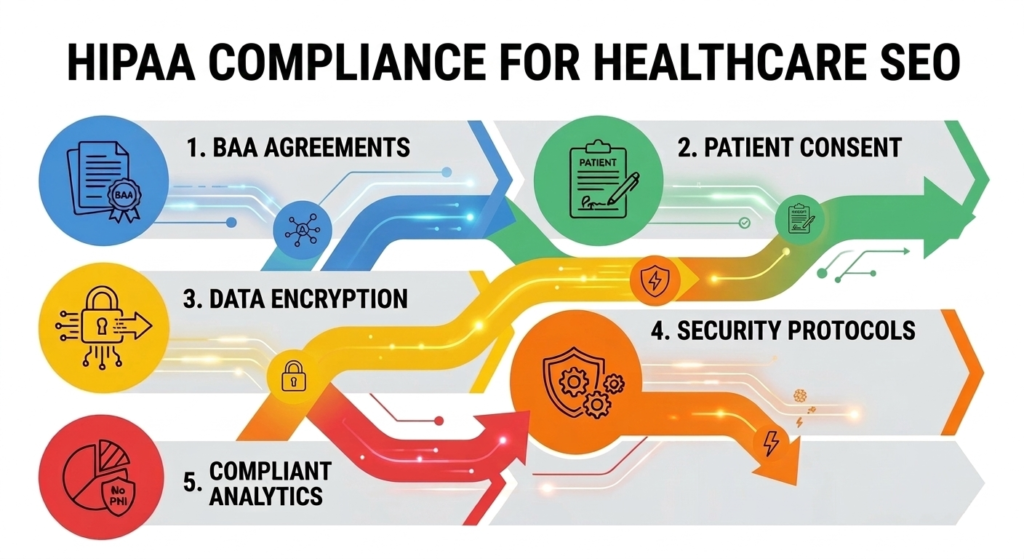
Here’s what healthcare websites need:
- SSL/TLS Encryption (HTTPS) – Non-negotiable
- HIPAA-Compliant Hosting – Servers with BAAs
- Secure Contact Forms – Encrypted data transmission
- Privacy Policy – HIPAA-specific language
- Cookie Consent – GDPR/CCPA compliant
- BAAs with All Vendors – Analytics, hosting, email, CRM
- Patient Portal Security – Two-factor authentication, encryption
Generic agencies use standard hosting, skip the BAAs, implement non-compliant forms, and expose clients to massive liability, often without realizing any of it is happening.
Local SEO for Healthcare Services
Standard local SEO means Google Business Profile, Yelp, and a handful of local citations. Healthcare local SEO means all of that plus Healthgrades, Zocdoc, Vitals, RateMDs, the WebMD Physician Directory, Wellness.com, ShareCare, Doximity, state medical board listings, hospital affiliation pages, and insurance provider directories – 15 to 20 platforms where NAP (Name, Address, Phone number) consistency has to be exact. One inconsistency across that network tanks local rankings.
E-E-A-T: Why It’s Non-Negotiable in Medical SEO
E-E-A-T stands for Experience, Expertise, Authoritativeness, and Trustworthiness. Google applies it to every site, but applies it most aggressively to healthcare because medical misinformation causes real harm to real people.
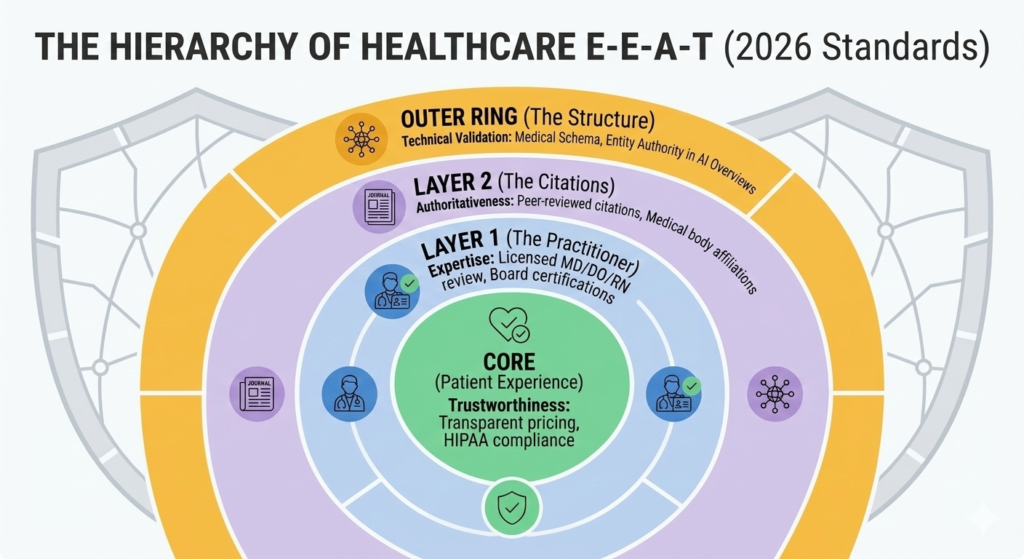
Here’s what each signal actually looks like in a medical context:
Experience Signals:
- Real patient case studies (HIPAA-compliant)
- Specific treatment protocols described
- Before/after documentation (with consent)
- Years of practice experience quantified
Expertise Signals:
- Licensed physician credentials (MD, DO, DDS, DVM)
- Board certifications
- Medical school and residency
- Continuing medical education
- Specializations and subspecialties
Authoritativeness Signals:
- Publications in medical journals
- Speaking engagements at medical conferences
- Hospital affiliations
- Medical association memberships (AMA, specialty boards)
- Citations from other medical professionals
Trustworthiness Signals:
- Transparent pricing and insurance information
- Clear privacy policies
- Secure website (HTTPS)
- Professional certifications displayed
- State medical license verification
- Positive review patterns across healthcare platforms
Building all of this from scratch, on your own, for a single client, is a significant undertaking. Which brings us to the actual solution.
Read More: Experience vs Expertise: The Core of Google EEAT in SEO
The White-Label Healthcare SEO Advantage
Agencies trying to serve healthcare clients without specialized support tend to end up with a patchwork of half-measures: a HIPAA disclaimer here, a physician byline there, a BAA with one vendor but not the others.
It feels like progress. But patchwork compliance isn’t compliance; it’s exposure with paperwork on top of it. It’s super easy to think you’ve covered your bases and discover, during a client’s audit, that you’ve only covered some of them.
If you’re serious about serving medical clients at scale, the honest math points in one direction: partnering with a specialized white-label healthcare SEO provider.
This means your clients get access to physician-reviewed content, documented HIPAA processes, medical-specific schema markup, and BAAs across all vendors without your agency building any of that from scratch.
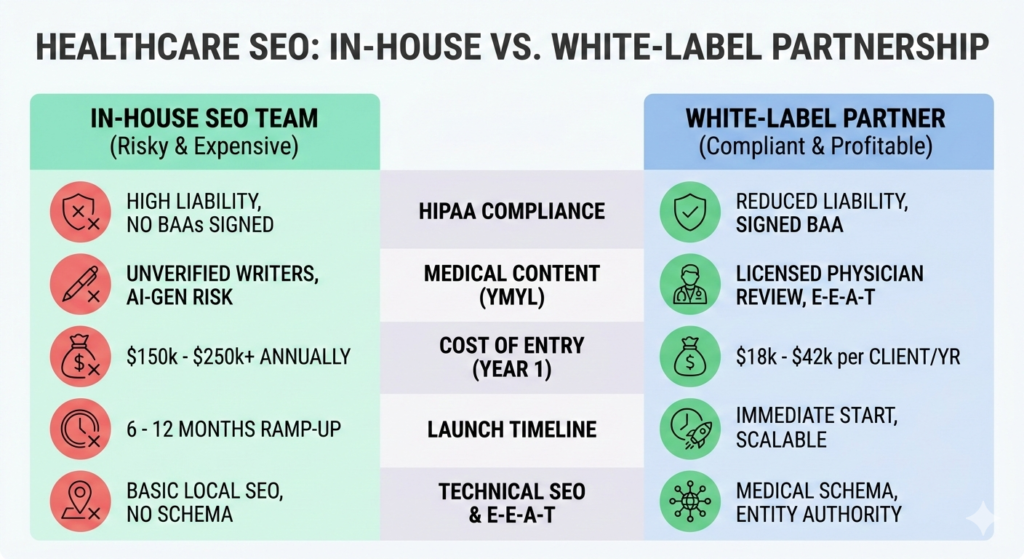
Immediate Compliance Expertise
Without White-Label Partner:
- Hire healthcare SEO specialist: $75,000-$95,000/year
- Hire HIPAA compliance consultant: $120-$250/hour
- Train team on medical regulations: 3-6 months
- Develop physician review relationships: 6-12 months
- Build compliant systems: $20,000-$50,000
- Total Year 1: $150,000-$250,000 + 12-month ramp-up
With White-Label Partner:
- Partner cost: $1,500-$3,500/month per client
- Immediate access to compliance systems
- Established physician review network
- Documented HIPAA processes
- Total Year 1: $18,000-$42,000 per client, immediate start
Savings: $132,000-$208,000 for a single client, exponentially more as you scale
Read More: White-Label vs Freelancers vs In-House SEO: Cost Comparison
Risk Mitigation and Liability Protection
The liability math is even clearer.
Your Liability Without Partner:
- Responsible for all HIPAA violations
- Liable for YMYL compliance failures
- Exposed if the client faces medical board action
- No recourse when AI content causes harm
Protection With Specialized Partner:
- Partner maintains HIPAA compliance systems
- Content review processes documented
- Professional liability insurance coverage
- BAAs in place with all vendors
- Quality assurance prevents violations
Real Value: Avoiding one $50,000 HIPAA fine pays for 14-33 months of partnership.
Scalability Without Proportional Risk
When your agency grows from 3 healthcare clients to 15, the in-house model requires hiring three to four additional specialists at $225,000–$380,000 per year with five times the audit exposure.
In the white-label model, the same partner handles 15 clients, compliance risk doesn’t compound, and volume discounts reduce your per-client cost by 10-20%.
This is what load-testing your business model looks like. Not waiting for it to break under real pressure, but building the right infrastructure before the cracks show up.
How White-Label Partners Build E-E-A-T
- Content reviewed by licensed physicians
- Author bios with full credentials
- Citations to peer-reviewed sources
- Backlink campaigns targeting medical websites
- Reputation management across healthcare platforms
Read More: The Hidden $180K Cost of In-House SEO
Checklist: How to Vet a Healthcare White Label Provider
1. HIPAA Compliance
Ask: Do they have documented HIPAA procedures, BAAs for vendors, and clear processes for handling patient testimonials and photos? Is their team trained in HIPAA?
Red flags: No documentation, unfamiliar with BAAs, “we’ll figure it out.”
2. Medical Content Review
Ask: Who reviews content for medical accuracy? Are reviewers licensed professionals? How is medical information verified and cited?
Red flags: No physician review, AI-only content, unlicensed “medical writers.”
3. Healthcare Technical SEO
Ask: Do they implement medical schema, HIPAA-compliant analytics, healthcare directory management, and proper security protocols?
Red flags: Generic schema, standard analytics without BAAs, limited healthcare platform knowledge.
4. Healthcare Track Record
Ask: How many healthcare clients do they serve? Can they provide healthcare case studies? Which verticals do they specialize in?
Red flags: No healthcare portfolio, generic examples, vague compliance history.
5. YMYL and E-E-A-T Knowledge
Ask: How do they meet Google’s YMYL standards, build E-E-A-T signals, and update content when medical guidelines change?
Red flags: Doesn’t know YMYL or E-E-A-T, no update process.
6. Insurance and Liability
Ask: Do they carry professional liability insurance, and who is responsible if a compliance violation occurs?
Red flags: No insurance, vague liability terms, no documentation.
Read More: White-Label Integration Playbook for Agencies (First 90 Days)
So What Now?
Since Google’s YMYL standards apply strictly to medical content, compliant content written with real physician credentials will rank, while non-compliant content gets buried regardless of your backlink profile. And since HIPAA-compliant systems build genuine patient trust, visitors are more likely to book an appointment and follow through.
If you haven’t been paying attention to healthcare compliance in your SEO work, here’s a quick checklist to get started:
- Check whether your current analytics setup has BAAs in place with every vendor touching the client’s website.
- Review any patient testimonials or photos for HIPAA-compliant written authorization, not just a checkbox consent.
- Audit your medical content for physician credentials, current clinical citations, and E-E-A-T signals Google can verify.
- Set up continuous monitoring of critical pages (booking flows, intake forms, treatment pages) so compliance gaps don’t quietly accumulate.
- Never assume one fix is permanent. HIPAA rules get updated. Google’s medical quality standards evolve. Compliant healthcare SEO is a moving target.
Start taking compliance seriously today, and you’ll find it does something most SEO efforts can’t claim: it protects your agency from $50,000-$500,000 in fines and grows your client’s traffic at the same time.
Need compliant healthcare SEO for your clients? Talk to experts.
FAQ
Healthcare SEO requires HIPAA-compliant systems, physician-reviewed content that meets Google’s YMYL standards, medical schema markup, and presence across healthcare directories like Healthgrades and Zocdoc. Generic SEO ignores these requirements, which can lead to compliance risks and significant traffic loss.
Yes. HIPAA applies to all healthcare providers, including dental practices. A qualified provider ensures BAAs with vendors, compliant forms and patient portals, secure hosting, and legally compliant testimonial processes.
Google holds medical content to strict accuracy standards. Content should be written or reviewed by licensed professionals, cite reliable medical sources, and stay updated with current guidelines. Sites that ignore these signals often lose rankings and visibility.
Yes. Any provider handling patient data should sign a BAA. This agreement defines how protected health information is secured, how incidents are reported, and who is responsible if a breach occurs.
Non-compliant providers can expose clients to HIPAA violations, search penalties, and serious reputational damage. In healthcare marketing, compliance failures often lead to immediate client termination.
Reputable agencies use physician review, cite authoritative sources such as medical journals and major health organizations, and regularly update content as medical guidelines change.
Yes. Hospitals require large-scale optimization across many departments and physicians, while private clinics focus more on local SEO and individual practitioner reputation. Both still require HIPAA compliance and strong medical content standards.
A strong program should provide HIPAA-compliant systems, physician-reviewed content, medical schema implementation, healthcare directory management, and reporting that tracks traffic and patient inquiries.
SEO helps practices build credibility through clear physician credentials, educational content, verified reviews, secure websites, and strong local visibility.
Medical schema helps search engines understand physician credentials, specialties, and services. This improves visibility in search features, rich results, and AI-generated health answers.