


TL;DR
- Google is shifting search toward AI Overviews that give instant, AI-generated answers at the top of SERPs.
- Google’s AI Overviews have become critical for visibility and CTR.
- Traditional keyword-based SEO is giving way to context, intent, and semantic relevance.
- Appearing in AI Overviews requires E-E-A-T-aligned content, structured data, and domain authority.
- Organic rankings still matter, but CTR drops because users get answers directly in AI summaries.
- AI-aware SEO and entity-focused content are pivotal to maintaining visibility in 2026.
Introduction
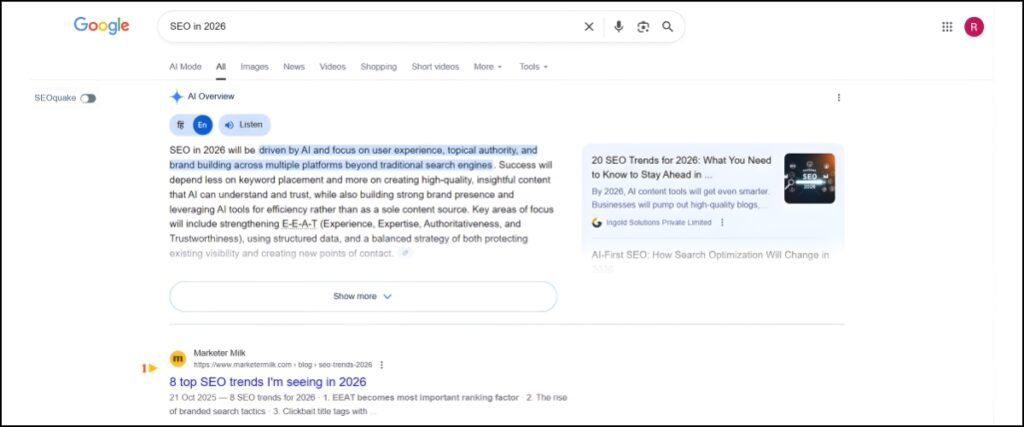
Google has already taken important steps towards a significant change in how we search and find answers. Google’s AI Overviews now provide AI-curated answers with citations from authoritative sources directly at the top of search results (see image below). This feature evolved from the experimental Search Generative Experience (SGE) that began in 2023.
Today, traditional algorithms are slowly evolving and giving way to real-time content generated by AI. And, direct answers to queries are steadily appearing at the top of search results on every major search engine.
With AI-focused SEO trending, businesses are now focusing on Gen AI to reshape their content strategy and improve their online visibility through the lens of generative intelligence.
Google’s Big Shift Toward AI in Search
The SEO world has been abuzz over Google AI Overviews, which are pushing search results below. That means even the search engine giant is not immune to AI’s potential, and the world is witnessing a shift towards AI in Search. Now, Google’s answers are no longer only about providing good information from the most credible sources; there is a lot of intent and context involved, too.
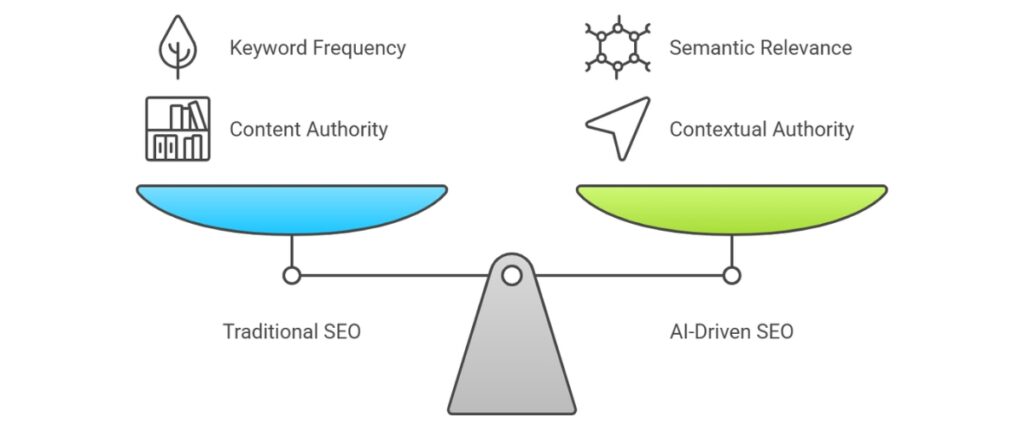
Therefore, search is more dynamic and has that ‘personalized’ touch that was missing from Google’s SERPs. Leveraging Gen AI, Google is now giving greater weight to semantic relevance than to the mere occurrence and frequency of target keywords in content. All in all, to rank high and sustain visibility for the long term, businesses need to focus more on context and authority than on the top mix of keywords alone.
Google AI Overview SEO: What’s Changing?
Google AI Overviews provide concise summaries in response to user search queries. They appear right at the top of a SERP and include information pulled from various authoritative sources. These sources are also listed as citations below the answer. That means users can read the summary within the SERP itself and also explore further if they want.
What does this mean for businesses looking to rank high on Google? Now, you need to focus more on structured data and content clarity to help them get featured in Google AI overviews or included in the citations below the response. While you should still aim for higher rankings, including AI-friendly content styles such as FAQs, schema, and listicles has become increasingly important.
Google Algorithm Evolution: From Updates to AI Overviews
2010–2016: Era of Panda, Penguin, Hummingbird
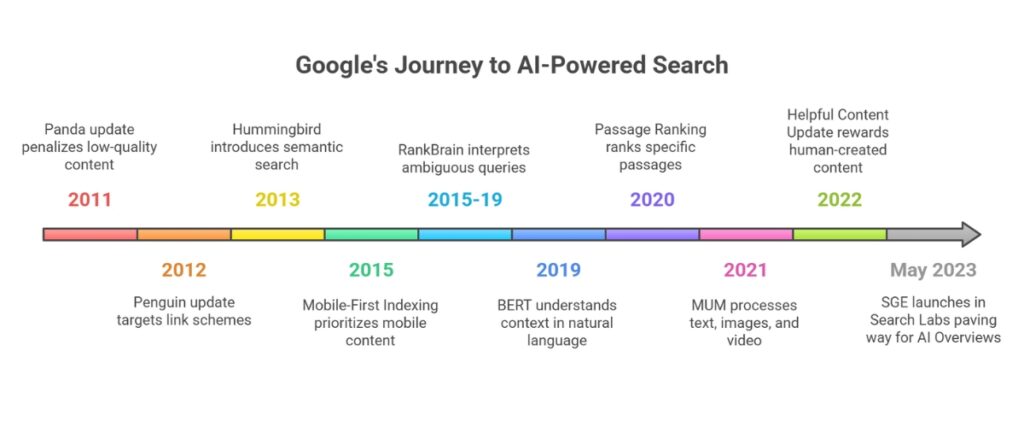
Google began its famous penalization wave, cutting out low-quality content and targeting spammers. It introduced semantic search, which helped rank content and web pages increasingly based on intent rather than merely on keywords.
2017–2022: RankBrain, BERT, MUM
This marked the entry of AI into search and focused primarily on natural language (BERT) and the Multitask Unified Model, or MUM, which brought text, images and video together, a precursor to modern generative AI. It also helped improve query interpretation through RankBrain.
2023–2024: Search Generative Experience (SGE)
SGE launched in May 2023 as an opt-in experiment in the U.S. Google tested how users interact with AI-generated answers and refined the experience based on feedback.
2024 and Beyond: The AI Overview Era
The present stage of Google’s search evolution mostly focuses on AI Overviews, offering real-time summaries in the SERP from credible sources across the web.
What Has Actually Changed for SEO?
SEO has undergone incredible evolution, and Google has shown the path to bringing AI right into the search realm. The standout changes that we are witnessing include:
- Search is no longer just keyword-based; it’s now more contextual and dynamic.
- Gen AI responses focus more on authoritative, trust-based content and structured data.
- More than keywords and the consequent rankings, SEO now focuses on how AI interprets your content and adds your website to its citations.
Does Google’s AI Overviews Impact Rankings?
AI overviews do NOT directly change rankings, which are still important. This is a common misconception. The actual change has been in CTR, impressions and user journey. CTR has declined by 60-65% for queries with AI Overviews. However, websites cited within AI Overviews earn 35% more organic clicks than non-cited competitors.
The websites cited in Google AI overviews have structured data and strictly follow the EEAT content guidelines (Google’s quality framework for evaluating content credibility). Using schema-rich content and FAQs also increases the likelihood of being featured in AI Overviews.
Overall, AI Overviews have not affected the rankings much, but they have given a clear indication to include more context and intent-based content, and to provide credible information to users to appear in Google AI Overviews or citations.
Also Read: The Two E’s of Google EEAT: Experience vs Expertise in SEO
AI-Aware SEO: What Businesses Need to Change?
A business that focuses only on SEO and misses out on Answer Engine Optimization (AEO) is more likely to lose the AI race. Google’s AI inclination is prompting more brands to incorporate trust, authority, structure, and intent into their strategies to make the most of AI in Search.
1. Optimize for Entities, Not Just Keywords
Focus more on entities (distinct concepts, people, places, things, or ideas that exist independently) and provide concept clusters. It is critical to include topics, subtopics, related topics and so on to build content that is useful, credible, and insightful to users. A user seeking information would need high-quality content related to the search query. You can provide insights into your business or service through content that focuses on people, actions, pain points, and other aspects of your niche.
2. Add Structured Data Everywhere
Lists, bullet points and direct answers to questions are important. Therefore, there’s greater emphasis on using schema markup for FAQs, HowTos, LocalBusiness, Articles, Products, etc. It improves your chances of inclusion in AI summaries. For location-focused brands, this is even more critical and can be supported by White Label Local SEO Services.
3. Increase Content Depth & Trust Signals
Google’s EEAT guidelines, which affect search results, require in-depth answers and domain authority. If you reflect expertise and concept clarity through your content, you can improve your chances of appearing in AI overviews. Include citations, internal linking, author bios, case studies, expert quotes, etc., to establish domain knowledge. Partnering with White Label SEO Content Writing teams can help scale high-quality content and maintain consistent authority.
4. Use AI-Optimized Content Layouts
Lastly, let your content flow in the layout the AI prefers. Using AI-optimized layouts, such as definition boxes, lists, question and answer sections, helps break the content monotony, providing hierarchy and intent to the content.
AI-Focused SEO Strategies for 2026
Here is a quick list that can help your business stay competitive and ahead in Google AI Overviews:
- Integrate AI Tools for SEO Efficiency: AI tools help in clustering existing content and analyzing SERPs, and further support on-page optimization in less time.
- Create Experience-Based Content: Provide case studies, insights, and authentic data that is correct and useful.
- Use Schema Updates: Schema markup and content forms are critical.
- Work with White Label SEO Services: Specialized White Label Services can help scale AI-optimized content across multiple channels consistently.
How to Get Featured in Google AI Overviews?
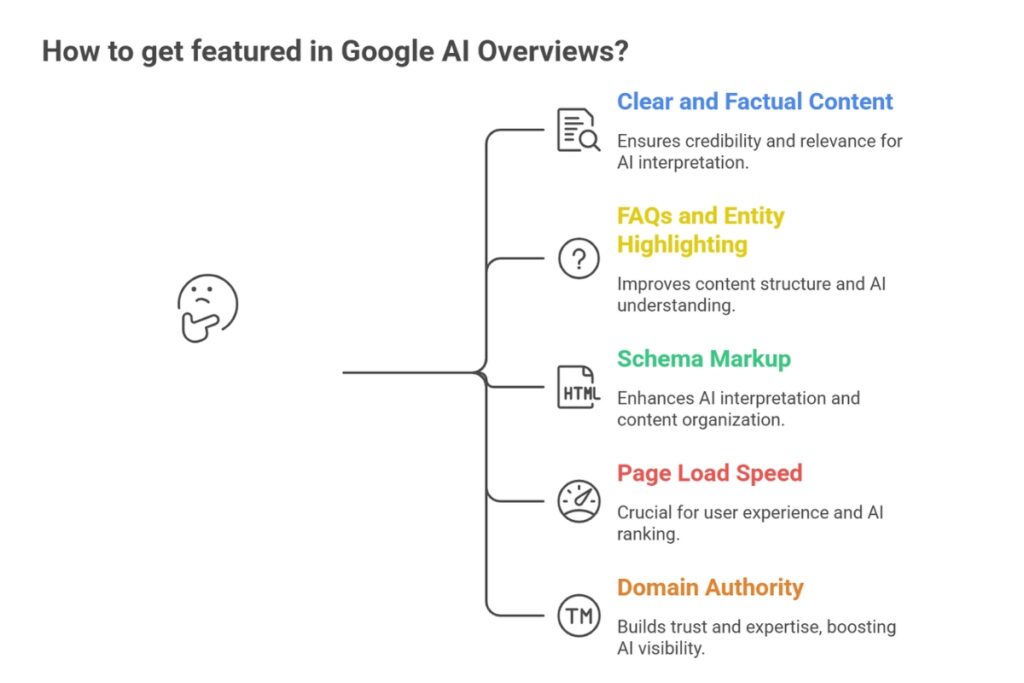
As stated earlier, focus on factual information and structure (not just keywords) to get space in Google AI Overviews. Some important considerations include:
- Keep content clear and factual. No fluff and no false claims.
- Use FAQs and highlight content sections on important entities.
- Use schema markup and structure the content to make it easier for AI to interpret.
- Never underestimate the importance of good page load speed.
Domain authority is critical, and expertise takes your content a long way.
Why AI in Search Makes White-Label SEO More Valuable?
Optimizing for AI in Search may not be as feasible and doable for agencies and marketers. It often requires the expert support of White Label SEO services. They are more adept at navigating evolving SEO trends and help build AI-based strategies that focus on traditional SEO fundamentals, incorporate AI-driven approaches, and include reporting practices.
Justwords is your trusted White Label SEO provider, creating seamless SEO workflows in the AI era, scalable content production, and quick adaptation and integration with ever-changing search engine algorithms.
Conclusion
The gradual shift in Google’s algorithm updates toward AI Overviews has accelerated and is entering a new evolutionary phase. Businesses that understand the changing trends and leverage AI to improve their rankings and visibility on Google AI Overviews need to build more AI-driven strategies in 2026 and beyond. Book a quick discovery call with them…
FAQs
Q1: What is Google’s AI Overview, and how does it work?
It’s an AI-generated summary shown at the top of search results, combining multiple web sources into a single overview.
Q2: How does AI in search change SEO strategy for 2025?
It prioritizes semantic relationships, topical authority, and E-E-A-T signals instead of just keyword matching.
Q3: How do you optimize for Google AI Overview SEO?
Add structured data, focus on topic clusters, improve content clarity, and demonstrate credibility through sources and expertise.
Q4: Will AI-focused SEO replace organic traffic?
No—but it will redefine it. Organic visibility depends on inclusion in AI Overviews rather than only on blue-link rankings.
Q5: Do backlinks still matter in an AI-first search world?
Yes, but quality and relevance outweigh quantity. AI uses links to assess trust and authority signals.
Q6: How can businesses stay competitive in AI-driven search results?
Businesses need to ensure their content follows the E-E-A-T guidelines, schema markups, and structured data. They also need to employ AI-assisted SEO tools to keep pace with current AI in Search trends.