


TL;DR
- Ecommerce SEO is specialized. Large catalogs, faceted navigation, duplicate content, and complex site architecture require expertise beyond standard SEO.
- Optimized product and category pages increase organic traffic and conversions.
- Schema, category hierarchy, inventory changes, and platform-specific execution matter.
- White-label SEO services enable agency scale. Agencies deliver ecommerce SEO without hiring in-house specialists.
Your agency just landed an ecommerce client with 5,000 products, three categories, and aggressive revenue targets. Then reality hits: ecommerce search engine optimization (SEO) is a completely different animal. Faceted navigation creates thousands of duplicate URLs. Product pages lack schema. Category structures confuse users and search engines alike. Inventory fluctuates seasonally, which causes indexing nightmares.
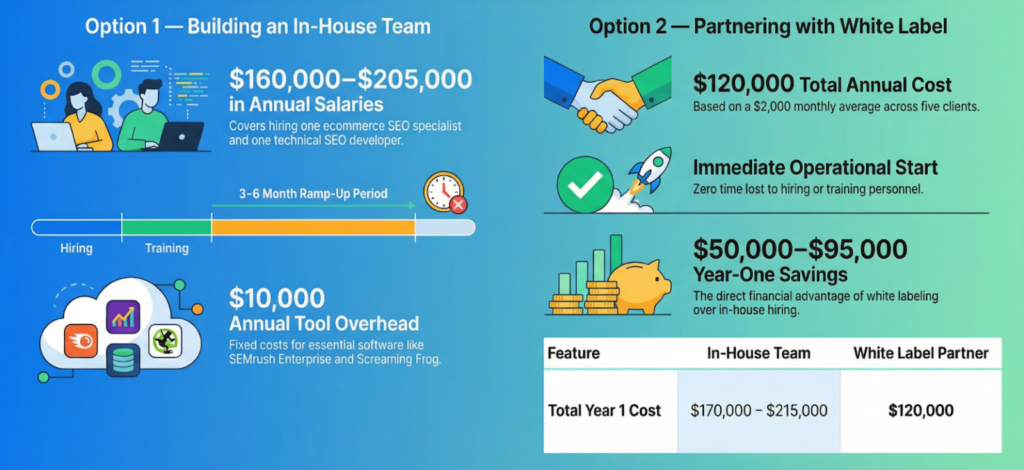
Building in-house expertise would cost $120,000+ annually in new hires and months of ramp-up. That’s why savvy agencies partner with white-label SEO vendors who specialize in ecommerce SEO services: they handle technical complexity while you keep client relationships and healthy margins.
In this blog post, we break down the real challenges, strategies, and scalable models behind modern ecommerce SEO services.
The Complexity of Modern Ecommerce SEO Services
Ecommerce SEO fails when agencies treat it like “SEO, but with products.”
It looks deceptively simple from the outside. Rank product pages. Optimize categories. Build links. Done.
In reality, product-based SEO is one of the most operationally complex SEO disciplines in 2026.
Let’s look at the key complexities unique to ecommerce sites.
Challenge 1: Scale and Technical Architecture
Here’s the part most agencies underestimate. A standard local business website might have 20-50 pages that need optimization. An ecommerce website, on the other hand, can have anywhere from 500 to 50,000+ pages. Every product, every category, every filter, every variation spins up new URLs.
At that scale, site architecture starts deciding whether Google can even understand your site. And the crawl budget becomes real.
Technical Hurdles:
- Faceted navigation: Filters create thousands of URL variations
- Pagination: Multi-page categories need correct canonical handling
- URL Parameters: Sorting options generate duplicates
- Crawl budget: Google won’t crawl infinite variations
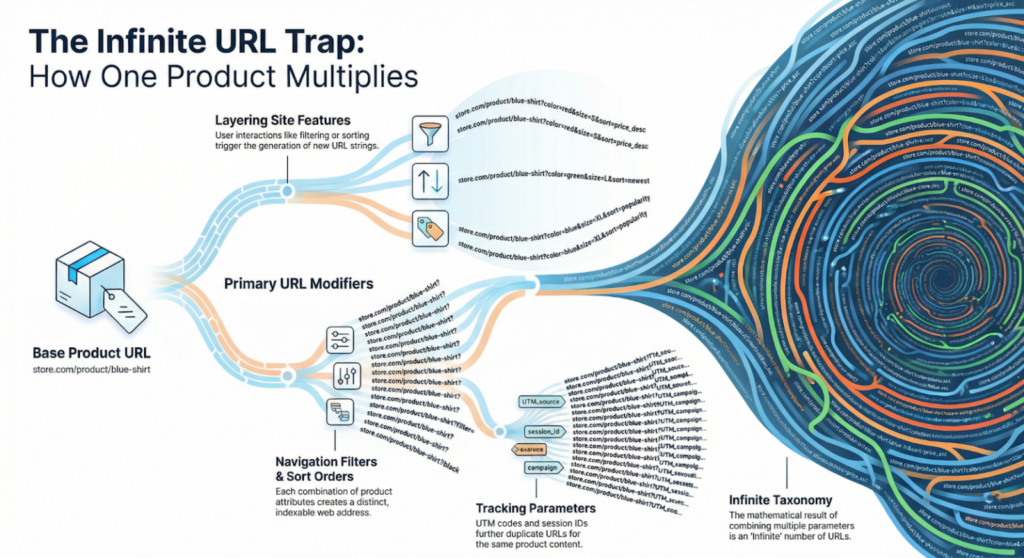
This is where generic agencies fall apart. Without ecommerce-specific technical knowledge, they let Google index thousands of filter URLs, burning crawl budgets on junk. They trigger duplicate content issues across product variations. And they build site structures that search engines struggle to navigate efficiently.
Challenge 2: Duplicate Content at Massive Scale
Duplicate content isn’t an edge case in ecommerce. It’s the default state.
Manufacturer descriptions are copied across hundreds of sites. Similar products reuse the same structure with tiny wording changes. Color and size variations share identical descriptions. The same product appears under multiple categories, each with its own URL. Multiply that by thousands of SKUs, and you’ve got a huge duplicate content problem.
The standard agency response is rewriting every product description manually, which is wildly expensive and painfully slow.
Challenge 3: Inventory Management and SEO
Inventory volatility is something most SEO playbooks don’t account for. Products go out of stock. New ones launch. Old ones disappear. And every one of those changes has SEO consequences.
The wrong approach is depressingly common:
- Delete out-of-stock product pages (lose accumulated SEO value)
- 404 errors for unavailable products (poor user experience)
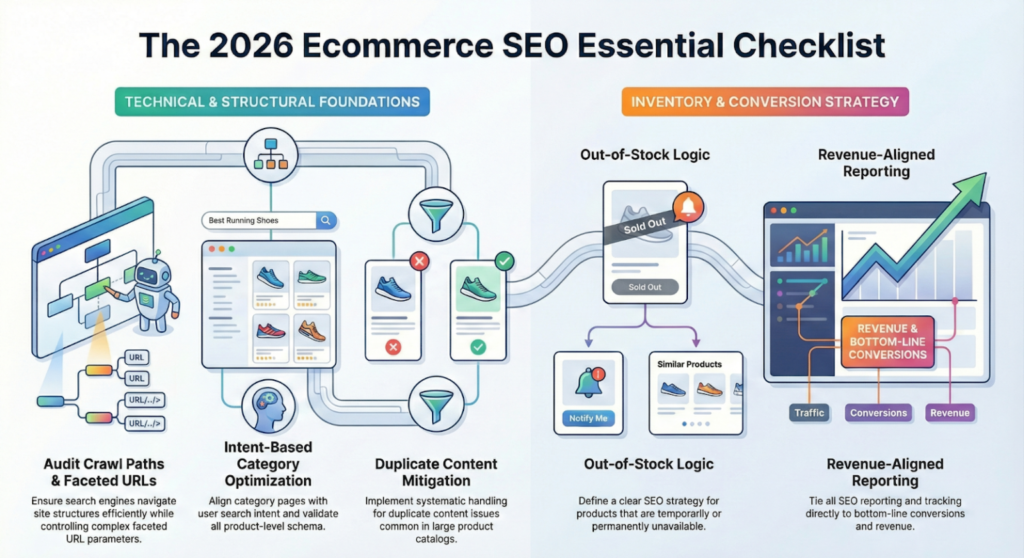
- Generic “out of stock” message without alternatives
A smarter ecommerce SEO strategy treats inventory changes as expected, not exceptional. Here’s how:
- Keep pages live with “notify when available.”
- Suggest similar products.
- 301 redirects only for permanently discontinued items.
- Use product availability schema (InStock, OutOfStock, PreOrder).
- Maintain category optimization despite stock changes.
Challenge 4: Product Schema Complexity
LocalBusiness schema might be enough for a dentist or a cafe. For ecommerce, it barely scratches the surface.
Product pages need a layered, precise schema to perform properly in search. When implemented correctly, this unlocks rich results (star ratings, price ranges, stock availability) directly in the search engine results page. It also improves eligibility for Google Shopping, supports voice search, and consistently increases click-through rates.
The catch is scale. Manually implementing schema across 5,000 products is simply inefficient. Ecommerce SEO requires automated schema generation tied directly into your platform and product feeds.
Challenge 5: Category vs. Product Page Strategy
One of the most misunderstood decisions in ecommerce SEO is figuring out which page should rank for transactional keywords.
Take a keyword like “blue running shoes.”
Product Page Approach: Targets specific models → detailed info, higher conversion, but rankings fluctuate.
Category Page Approach: Targets broader terms → stable rankings, showcases multiple options, but potentially lower conversion.
Strategic Answer: Both, strategically.
Category pages target broader, high-volume terms like “running shoes” or “blue sneakers.” Product pages target model-level queries like “Nike Air Zoom Pegasus 40.” Internal linking connects the two, so authority flows naturally and search engines understand the hierarchy.
Understanding this strategy requires ecommerce-specific SEO knowledge. Generic agencies optimize randomly without a strategic hierarchy.
Also Read: How to Fix and Prevent Keyword Cannibalization in SEO
Essential Strategies for Ecommerce SEO Marketing
Strategy 1: Technical Site Architecture
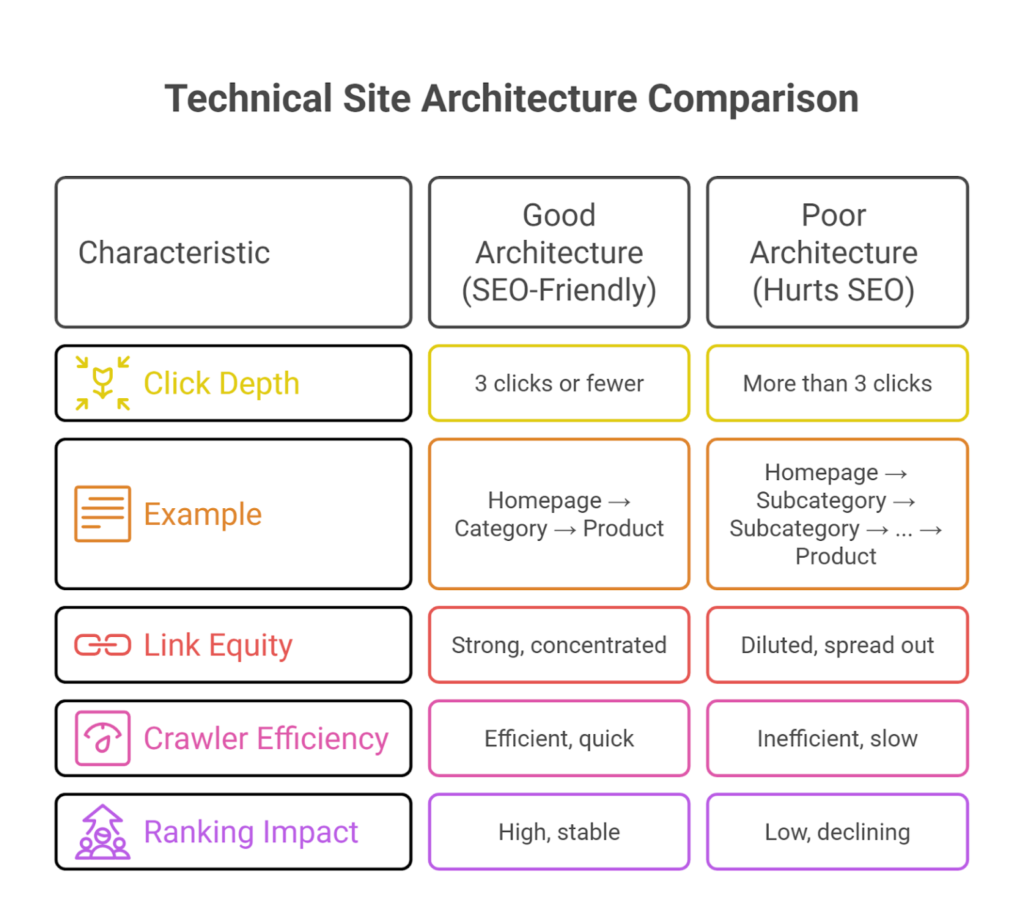
Use flat architecture always. The goal is simple: a user (and a crawler) should reach any product in 3 clicks or fewer.
What good architecture looks like (SEO-friendly):
Homepage → Running Shoes (Category) → Nike Air Zoom Pegasus 40 (Product)
Poor Architecture (Hurts SEO):
Homepage → Shoes → Athletic → Running → Brands → Nike → Air Series → Pegasus → Version 40
Every extra click away from the homepage weakens the page’s perceived importance. Link equity gets diluted. Crawlers get tired and rankings slip.
How to implement site architecture properly:
- Limit category depth to 2-3 levels max
- Use breadcrumb navigation
- Implement HTML sitemap for complex structures
- Strategic internal linking to boost key products
Also Read: 11 SEO-Friendly URL Best Practices for Higher Rankings
Strategy 2: Leveraging Product Schema Markup
Critical schema types for ecommerce sites:
- Product Schema – Name, image, description, SKU, brand
- Offer Schema – Price, currency, availability, condition
- AggregateRating Schema – Star ratings from reviews
- Review Schema – Individual customer reviews
- BreadcrumbList Schema – Site hierarchy navigation
- Organization Schema – Store/brand information
For 5,000+ products, schema must auto-generate from the product database. White-label partners already have systems for this; agencies building in-house face months of work.
Strategy 3: Category vs. Product Page Optimization
Category pages exist to rank. Product pages exist to convert.
If you confuse the two, both underperform.
For example, see Nike’s well-optimized category page structure.
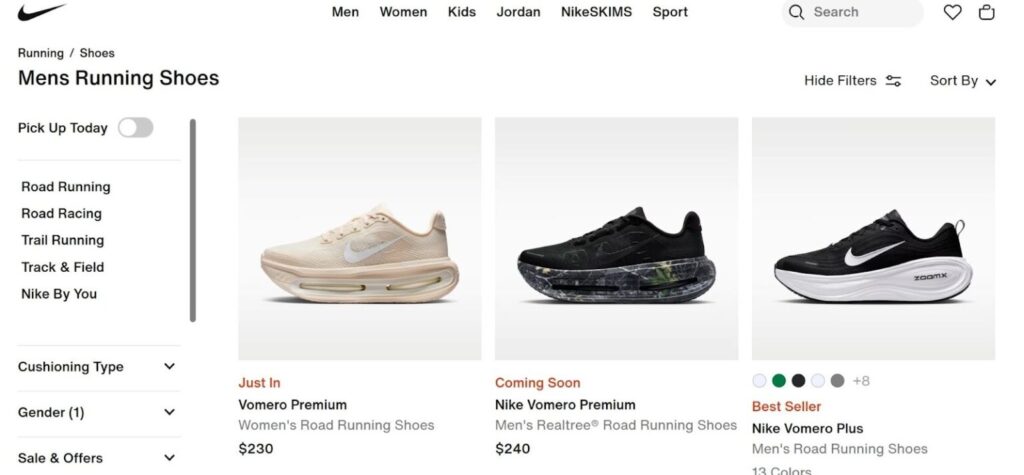
Category Page Best Practices
A category page is like a landing page.
Structurally, it needs:
- A clear H1 that matches search intent (not internal naming conventions)
- Introductory content that explains who the category is for and why it exists
- A product grid that’s filterable and fast
- Supporting educational content that helps users choose
- FAQs that capture long-tail queries and reduce hesitation
- Specs, size guides, or comparisons that add real utility
From an SEO perspective, that page must have:
- A unique meta title and description
- A single canonical URL
- Breadcrumb schema
- Filter and sort parameters controlled via canonicals or noindex
- Internal links to related categories and top-selling products
Product Page Best Practices
Product pages need to earn trust and close the deal.
That means the content structure must have:
- A clean, descriptive H1 that includes the primary keyword
- Multiple high-quality images from different angles
- A real description written for humans, not copied from the manufacturer
- Clear specifications that answer practical questions
- Reviews (minimum 5-10)
- Size and fit guidance to reduce returns
- Related products to increase cross-sell/upsell
- Trust signals (Return policy, warranty, secure checkout badges) that reassure hesitant buyers
SEO-wise, product pages need:
- Full product schema with price, availability, and reviews
- Unique meta descriptions
- Alt text on every image
- Strong internal links from categories and related products
- FAQ schema where applicable
Strategy 4: Internal Linking
A clean linking hierarchy looks like this:
- The homepage links only to core categories.
- Category pages link downward to subcategories, featured products, and buying guides that support decision-making.
- Product pages link back up via breadcrumbs, laterally via related products, and contextually to buying guides or educational content.
Anchor text strategy:
- Category links: Use category name + descriptor (“Men’s Running Shoes”)
- Product links: Use product name (“Nike Air Zoom Pegasus 40”)
- Avoid generic “click here” or “learn more.”
Strategy 5: Handling Faceted Navigation
Facets create infinite URLs.
Common solutions:
- Canonical tags for primary URLs
- Noindex low-value filter/sort pages
- Strategic rewriting only for high-value product pages
- Schema markup for variants
- Parameter handling in Google Search Console
This is where white-label ecommerce SEO partners consistently outperform generalist agencies. They’ve already solved this across Shopify, WooCommerce, and Magento.
Implementing White-Label SEO Strategies for Ecommerce
Every agency that thinks all SEO is the same eventually meets ecommerce and learns the hard way that it isn’t. Product-based sites don’t just add more pages; they add exponential technical complexity. Platforms behave differently, content doesn’t scale linearly, and a single mistake in configuration can wipe out thousands of URLs from search visibility overnight. This is exactly where white-label ecommerce SEO starts being a survival strategy.
Platform-Specific Optimization Made Easy
Different ecommerce platforms demand completely different SEO approaches.
Shopify, for example, seems simple. You can launch fast, but you sacrifice deep technical control. URL structures are rigid, duplicate content creeps in through product variants, and advanced schema often depends on third-party apps that don’t always play nicely with custom implementations.
WooCommerce sits at the opposite end of the spectrum. You have full technical control, but that control comes with responsibility. Poor hosting choices, bloated plugins, or unoptimized databases can kill performance at scale.
Magento adds another layer entirely. It’s powerful, flexible, and built for enterprise use, but it demands specialized expertise. URL rewrites, multi-store management, and faceted navigation require precision, not experimentation.
BigCommerce lands somewhere in between, offering solid built-in SEO features and strong APIs, but still presents challenges around category structures and filtering.
This is where white-label partners earn their place. They don’t learn platforms on your client’s site. They arrive with platform-specific playbooks, tested implementations, and pre-built solutions for the exact problems that trip most agencies up. Instead of weeks of trial and error, execution starts immediately.
Scaling Content Without Breaking Quality
Writing one strong product description takes time. Writing thousands manually is simply not viable.
The scalable approach starts with ruthless prioritization. High-revenue products deserve custom, conversion-focused descriptions. Mid-tier products benefit from enhanced manufacturer content with unique sections layered in. Long-tail or low-impact products need structured templates that introduce variation without sacrificing clarity or relevance.
Modern white-label content workflows combine structured templates, database-driven variables, and AI-assisted drafting, followed by human refinement. Agencies building these systems from scratch often restart for every client.
Delivering Product-Based SEO Services at Scale
This is where the business case becomes impossible to ignore. When agencies try to build ecommerce SEO capabilities in-house, costs compound quickly. Specialized hires are expensive, tools aren’t cheap, and ramp-up time delays results for clients who are already paying. By the time a team is fully operational, months have passed and expectations are already under pressure.
White-label partnerships flip that equation. Instead of hiring, training, and managing specialists, agencies tap into an existing delivery engine. Costs remain predictable, capacity scales instantly, and execution starts immediately. The savings aren’t just financial. They show up in faster time to results, higher client satisfaction, and far less operational drag on agency leadership.
Pricing product-based SEO services also becomes cleaner. Agencies can confidently package technical optimization, on-page work, content enhancements, and reporting into tiered offerings with healthy margins because fulfillment costs are controlled and outcomes are repeatable.
Why Agencies Need White Label Ecommerce SEO Partners
Agencies don’t lose ecommerce clients due to bad ideas. They lose them due to:
- Slow execution
- Technical debt
- Inconsistent optimization
- Poor revenue attribution
A strong white-label ecommerce SEO partner becomes a force multiplier. Here’s how:
- Technical complexity: Handle platform-specific SEO, faceted navigation, schema, crawl budget
- Scale without hiring: Handle 12 clients with the same partner vs. 6–8 specialists in-house
- Faster results: 4–8 weeks vs. 5–7 months
- Risk mitigation: Proven frameworks prevent costly SEO mistakes
- Focus on core business: 75% of time available for sales/strategy
This is how agencies scale ecommerce SEO without becoming an ecommerce development shop.
Read More: White-Label vs Freelancers vs In-House SEO: Cost Comparison
Final Thoughts
Ecommerce SEO marketing requires expertise that most agencies don’t have. Building in-house costs $170K–$215K/year plus months of ramp-up. White-label partners give immediate access to specialists, platform-specific solutions, and scaling systems. Agencies can charge $2,500–$8,000/month per client, maintain 45–60% margins, and focus on client acquisition while delivering results fast. The choice is clear: spend years building internally, or scale immediately with proven white-label partners.
FAQs
1. What are ecommerce SEO services?
Ecommerce SEO services focus on improving organic visibility for product and category pages, managing technical complexity, and driving revenue from search.
2. How much does ecommerce SEO cost?
Costs vary by catalog size and competition, but ecommerce SEO packages are typically more expensive than standard SEO due to technical and content scale. Small ecommerce stores with a few hundred products usually sit in the $2,500–$4,500 a month range. Mid-size catalogs (1,000–10,000 products) land closer to $4,500–$8,000. Large ecommerce sites with serious scale easily run $8,000–$15,000+. For agencies using white-label partners, costs are typically $1,000–$8,000 per month, which leaves healthy 40–60% margins. And if you are trying to build this in-house, expect $170K–$215K a year once you factor in specialists, tools, and ramp-up time.
3. What is included in comprehensive ecommerce SEO services?
Ecommerce SEO services cover the technical SEO audit (site architecture, faceted navigation, crawl control, speed), on-page optimization (product and category pages, internal linking, schema), content that actually sells (product descriptions, buying guides, FAQs), and conversion tuning.
4. How do white-label SEO partners handle duplicate product content?
Good white-label SEO partners control duplication strategically: canonicals point to primary URLs, low-value filter combinations get noindexed, and Search Console parameters tell Google what to ignore. High-value products get custom content; low-priority ones get enhanced, structured descriptions that stay unique without wasting time.
5. Why is technical SEO critical for ecommerce SEO marketing?
Because technical SEO directly affects how large catalogs rank. Bad architecture burns crawl budget. Faceted navigation explodes into thousands of junk URLs. Slow pages kill conversions. Missing schema means no rich results. Poor mobile experience sinks rankings when most traffic is mobile anyway.
6. Can white-label vendors work with custom ecommerce platforms?
Yes. Experienced white-label partners adapt SEO logic to custom stacks with proper technical collaboration.
7. How do I price product-based SEO services for clients?
Tie pricing to scale and revenue impact. Pricing should reflect SKU count, technical complexity, and revenue goals rather than flat SEO retainers.
8. What’s the difference between standard SEO and ecommerce SEO?
Standard SEO deals with a few dozen static pages. Ecommerce SEO manages hundreds or tens of thousands of dynamic URLs. It requires crawl control, inventory-aware strategies, automated schema, conversion optimization, and deep platform knowledge. Ecommerce SEO also involves product lifecycle management and revenue attribution challenges.
9. How do white-label strategies handle out-of-stock products?
By using conditional indexing, structured messaging, and internal link adjustments to preserve authority. Pages stay live with “notify me” options to capture demand. Similar products are surfaced to keep users shopping. The schema is updated to reflect out-of-stock status. Redirects are used only when products are permanently gone.
10. Why is schema markup essential for ecommerce sites?
Schema enables rich results, improves AI visibility, and helps search engines understand product data accurately.
11. How long does ecommerce SEO take to show results?
Typically 3–6 months for measurable impact, depending on site size and competition.
Next Blog For You: White-Label Integration Playbook for Agencies (First 90 Days)