
TL;DR
- Dental SEO in 2026 is no longer template-driven. Compliance, trust, and local nuance decide rankings.
- Generic SEO models fail dentists due to YMYL, HIPAA sensitivity, and patient intent complexity.
- Agencies scaling dental clients need specialized dental SEO partners, not freelancers or AI-only workflows.
- The right white-label dental SEO partner acts as a force multiplier, not just an execution vendor.
- Scalable dental SEO today requires deep content clusters, local authority, and airtight compliance.
Introduction
Dental SEO has quietly become one of the hardest verticals to scale in 2026. Search engines treat dental websites as high-risk, high-trust properties under Google’s Your Money or Your Life (YMYL) framework. Add to that fierce local competition, strict compliance expectations, and increasingly informed patients. Suddenly, the SEO template that worked for plumbers stops working entirely.
In 2026, most generalist agencies lose dental clients within a year. Not because they’re bad at SEO, but because they underestimate the complexity of dental SEO.
Agencies that are scaling dental SEO successfully aren’t relying on templates or stacking more tools. They are partnering with specialized dental SEO providers who understand YMYL, patient intent, medical accuracy, and local nuance. These partners act as force multipliers and help agencies grow dental accounts without sacrificing compliance, trust, or performance.
Here’s how.
Dental SEO in 2026: What Changed
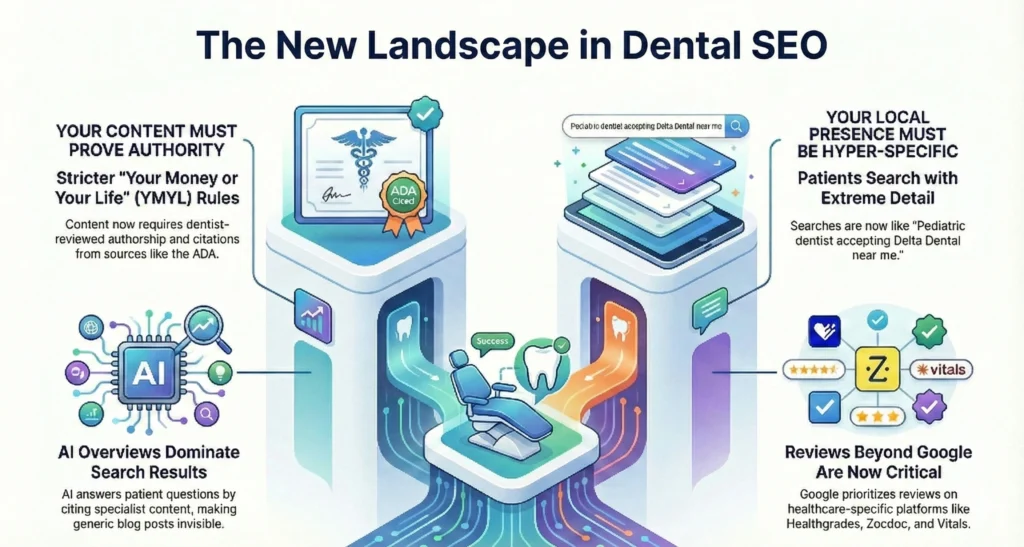
1. YMYL Enforcement Is No Longer Forgiving
What is YMYL? Content that could impact a person’s health, financial stability, or safety is subject to higher quality standards.
Dental websites fall squarely into YMYL territory. That means:
- Claims need citations (American Dental Association (ADA), Centers for Disease Control and Prevention (CDC), peer-reviewed sources).
- Content needs dentist-reviewed authorship.
- Outdated treatment info gets quietly buried.
- “Marketing Team” bylines kill trust signals.
Impact: Non-compliant dental sites saw significant traffic drops over the latest Google Core update cycles. In 2026, recovery is slow and painful.
2. AI Overviews Now Own Dental SERPs
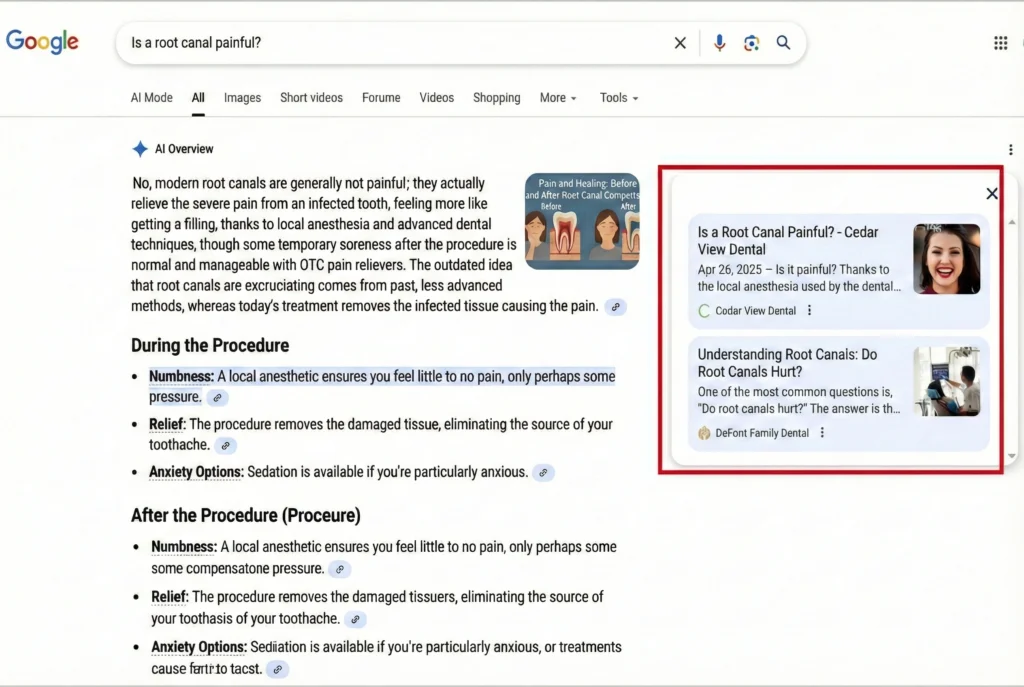
Dental searches trigger AI Overviews more than most industries. People often ask questions on Google like, “Is a root canal painful?” “How much do implants cost?” and “Is teeth whitening safe?”
For such queries, AI pulls answers from content that is medically accurate, well-structured, and strongly aligned with E-E-A-T (Experience, Expertise, Authoritativeness, and Trustworthiness) principles. (See below.)
Generic content doesn’t get cited. Specialist content does and steals visibility above page one.
3. Local Search Got Hyper-Specific
Patients search more than just “dentist near me” now. They search “Emergency dentist open now within 2 miles,” “Dentist accepting Delta Dental in Brooklyn,” and “Pediatric dentist near Bronx.”
That could result in 50+ local-intent variations per practice. Generic local SEO can’t capture this specificity.
4. Reviews Aren’t Just Google Anymore
Unlike other local businesses, dental practices need a presence on healthcare-specific review platforms like Healthgrades, Zocdoc, Vitals, RateMDs, and WebMD. Plus Google, Yelp, and Facebook.
Google prioritizes reviews on healthcare-specific platforms for medical queries. Managing this manually is where agencies waste time or mess it up completely.
Why “Cookie-Cutter” SEO Strategies Fail at Scale
Reason #1: Medical Accuracy Isn’t Optional
Generic approaches by agencies include AI-generated pages, vague “painless” claims, failure to cite medical sources, and stock medical imagery without attribution.
However, this often fails because Google detects medically inaccurate content. YMYL violations trigger deranking. And patients spot poor content and bounce. It also increases the risk of complaints about misinformation.
Specialist approach:
- Dentist-reviewed content
- Citations to ADA (American Dental Association), CDC, and peer-reviewed journals
- Realistic treatment expectations
- Author credentials front and center
Reason #2: Dental Sites Aren’t 10 Pages (They’re 40+)
Dental practices need pages for general care, cosmetic care, restorative care, orthodontic care, pediatric care, sedation, TMJ, implants, insurance, financing, aftercare, FAQs, and much more.
That’s 40–60 interconnected pages, not just “Services and Blog.”
Generic agencies simply don’t have the resources or expertise for this kind of depth.
Reason #3: Healthcare Citations Actually Matter
NAP (Name, Address, Phone number) consistency across 20+ healthcare directories isn’t “nice to have.” It’s a ranking factor.
One wrong phone number on Healthgrades can undermine local trust signals everywhere.
That’s why managing 20+ listings with consistent NAP, hours, insurance info, and photos requires specialized systems and ongoing monitoring.
Reason #4: Dentist-Specific Schema Is Required
Basic LocalBusiness schema isn’t enough.
Dental SEO requires the Dental, MedicalSpecialty, InsuranceNetwork, FAQ, Service, and more schemas.
This is how you qualify for medical SERP features and AI citations.
Reason #5: Patients Don’t Convert Like Homeowners
Dental decisions take weeks, not minutes. Content must match stages:
- Awareness: Symptoms & education
- Consideration: Procedures, cost, comparisons
- Decision: Credentials, reviews, insurance
- Retention: Aftercare, follow-ups
Generic “Book Now” CTAs ignore how humans actually choose healthcare.
The 3 Pillars of Specialized SEO for Dentists
1. Deep Content Clusters
High-performing dental sites build clusters around:
- Root canal recovery timelines
- Dental implant cost breakdowns
- Invisalign vs braces comparisons
- Emergency dental care scenarios

Example: Root Canal Content Cluster
Hub Page: “Root Canal Therapy: Complete Guide”
- What is a root canal?
- When you need one
- The procedure explained
- Cost and insurance
- Recovery expectations
Supporting Cluster Pages (10-15 articles):
- “Is a root canal painful? What to expect”
- “Root canal recovery time: Day-by-day guide”
- “Root canal vs. tooth extraction: Which is better?”
- “How much does a root canal cost in [city]?”
- “Root canal aftercare: Do’s and don’ts”
- “Does insurance cover root canals?”
- And so on…
Internal Linking Strategy: All cluster articles link back to the hub page. Hub links to all cluster articles. Cluster articles link to related clusters (e.g., root canal → dental crowns).
Result: Google recognizes your site as an authority on root canals. When patients search for any root canal query, you rank.
2. NAP Consistency for Local SEO for Dentists
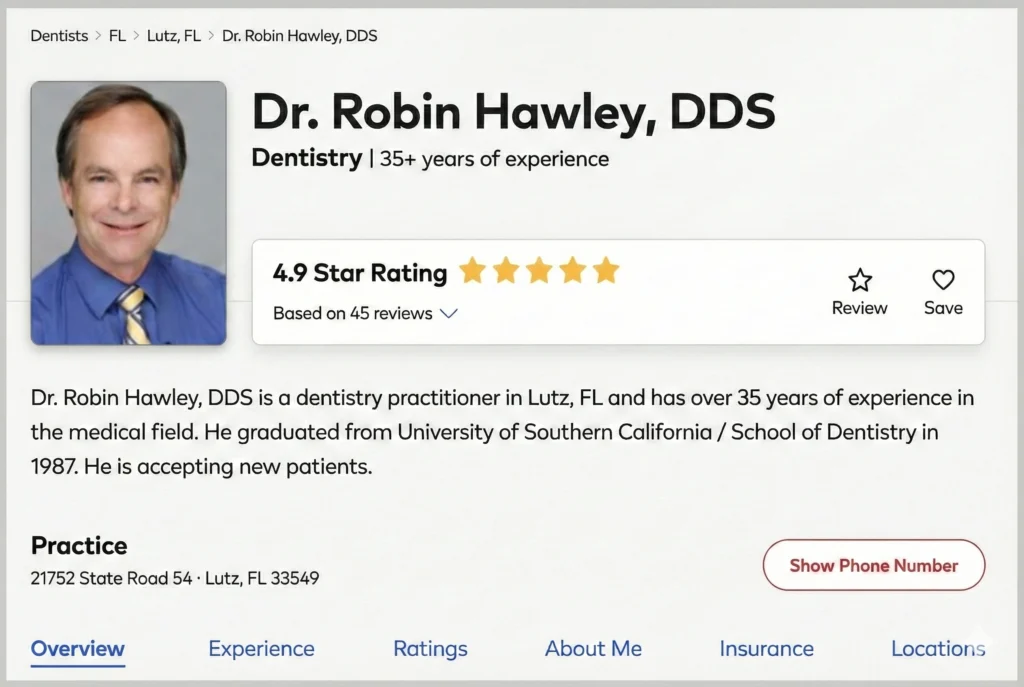
Dental SEO relies heavily on health-specific directories, insurance listings, and Google Business Profile accuracy.
Winning practices:
- Audit all listings monthly.
- Optimize Zocdoc & Healthgrades properly (see image below).
- Respond to reviews within 24–48 hours.
- Keep insurance and hours current.
This alone can lift local pack visibility 40–60%.
3. Schema Implementation That AI Can Trust
Correct schema improves CTR, unlocks rich results, feeds AI Overviews, and signals legitimacy to Google’s medical algorithms.
Specialized dental SEO uses:
- Dentist (primary LocalBusiness type)
- MedicalSpecialty (expertise areas)
- MedicalAudience (who you serve)
- InsuranceNetwork (accepted providers)
- AggregateRating (star ratings)
- FAQPage (patient questions)
- Service (each dental service)
Compliance & Trust: The Hidden Hurdles
HIPAA Compliance in Digital Marketing
Compliance is the part agencies don’t like talking about. HIPAA mistakes can lead to $10K–$50K fines, client loss, and reputation damage.
What is HIPAA? Health Insurance Portability and Accountability Act – protects patient health information privacy.
How HIPAA Affects Dental SEO:
- Patient Testimonials – Can’t use photos/names without written consent
- Before/After Galleries – Require signed authorization for every photo
- Contact Forms – Must use encrypted, HIPAA-compliant systems
- Email Marketing – Require consent, use compliant platforms
- Analytics – Need Business Associate Agreements (BAAs) with vendors
Specialists bake compliance into testimonials, galleries, forms, analytics, and email workflows. Generalists usually don’t know where the risks even are.
Google’s E-E-A-T for Medical Content
Google scrutinizes:
- Experience: Content by practicing dentists, real case studies, and specific procedure descriptions
- Expertise: Author credentials (DDS, DMD), dentist bios, ADA membership, certifications
- Authoritativeness: Backlinks from healthcare sites, citations, awards, media mentions
- Trustworthiness: Professional design, clear contact info, transparent pricing, HTTPS security
How to Build E-E-A-T:
- Dentist bylines on all content
- Comprehensive About pages with credentials
- Original research and patient data
- Citations to ADA, CDC, journals
- Third-party validation (reviews, BBB, awards)
YMYL Quality Standards
Google’s quality raters evaluate dental content more strictly than other industries. Here’s what gets flagged:
- Outdated treatment information
- Unsubstantiated claims (“painless,” “guaranteed”)
- Missing disclaimers
- Misleading before/after photos
AI-generated content without human review creates real ranking risk here. Sites violating YMYL standards get buried. And recovery takes 6-12 months.
This is why many agencies quietly move dental SEO execution to specialized white-label partners instead of scaling internally.
How a Specialized Dental SEO Partner Acts as a Force Multiplier
Here’s what agencies get wrong: they try to “learn dental SEO” client by client.
That’s expensive. Slow. Risky.
What specialists do:
- Serve 10–50 dental clients with the same team
- No in-house hiring
A true dental SEO partner doesn’t just “do tasks.” They help in multiple ways:
- Protect agencies from compliance mistakes
- Standardize dental-specific workflows
- Reduce revision cycles with dentists
- Maintain content quality at scale
- Support local SEO across multiple locations
For agencies, this means faster onboarding, lower delivery risk, higher retention, and better margins.
If your agency manages multiple dental clients, partnering with a white-label dental SEO expert can unlock scale without compromising trust.
Checklist: How to Vet Your White-Label Dental Partner
Use this before you outsource dental SEO:
- Do they understand YMYL and EEAT for healthcare?
- Can they create custom content clusters, not templates?
- Do they manage health directory citations?
- Can they implement medical-specific schema?
- Do they have dental-focused editorial guidelines?
- Can they scale content, local SEO, and reporting together?
Conclusion
Dental SEO in 2026 rewards specialization, not shortcuts. For agencies, the big question is whether your delivery model can handle the complexity of dental SEO.
The agencies winning dental aren’t doing everything themselves. They’re smart enough to partner with people who already know where the bodies are buried. That means pairing in-house strategy with specialized white-label partners who understand compliance, trust, and local nuance deeply.
At Justwords Digital, we have spent 15+ years mastering content-driven SEO, with specialized expertise in healthcare and dental practices. Book a discovery call with us and learn how you can scale from 5 to 50 dental clients without adding headcount.
FAQs
What is the biggest change in dental SEO strategies for 2026?
Dental SEO now prioritizes trust, compliance, and patient intent over keyword targeting, making YMYL and EEAT critical ranking factors. This shift is forcing agencies to rethink how they design, execute, and scale dental SEO strategies safely.
Why shouldn’t I use AI tools to write all my dental content?
AI lacks medical nuance and compliance judgment. Unchecked AI content risks inaccuracies, trust loss, and suppressed rankings under YMYL guidelines. Relying solely on AI also weakens long-term content marketing effectiveness.
How does local SEO for dentists differ from regular local SEO?
Dental local SEO depends on health directories, practitioner credibility, reviews, and stricter data accuracy than most local businesses. These differences significantly affect search results, especially in competitive metro and multi-location markets.
What is “YMYL” and why does it matter for dental websites?
YMYL covers content affecting health or finances. Dental sites fall under it, meaning Google applies higher standards for accuracy and trust.
How many service pages does a dental website actually need?
High-performing sites typically need 15–30 service and condition pages organized into intent-based clusters.
Can a generalist agency handle dental SEO effectively?
Usually not at scale. Dental SEO requires medical sensitivity, local expertise, and specialized workflows most generalists lack. Without dental-specific processes, even consistent SEO efforts tend to stall or regress after initial gains.
How do patient reviews impact dental search rankings?
Reviews influence local pack visibility, trust signals, and click-through rates, especially for competitive metro searches.
What are the risks of using “cookie-cutter” SEO templates for dentists?
They create duplicate patterns, compliance risks, weak authority signals, and inconsistent local performance. These templates also ignore healthcare-grade technical SEO requirements like medical schema and directory integrity.
How much does specialized dental SEO cost compared to generic SEO?
Upfront costs may be higher, but long-term ROI is stronger due to better rankings, retention, and lower rework.
How does voice search impact dental marketing strategies?
Voice queries are conversational and urgent, favoring FAQ-style answers and localized, intent-driven content.