
TL;DR
- AI-powered search is reducing clicks, not demand. SEO now competes inside AI answers, not just rankings.
- Agencies that win in 2026 focus on entities, topical authority, and usefulness, not volume.
- AI boosts speed and scale, but human judgment still determines rankings and trust.
- Predictive SEO, real-time monitoring, and AI-assisted workflows separate scalable agencies from struggling ones.
- The strongest agencies combine AI efficiency with disciplined editorial and delivery systems.
AI and SEO: How Agencies Can Stay Competitive in 2026
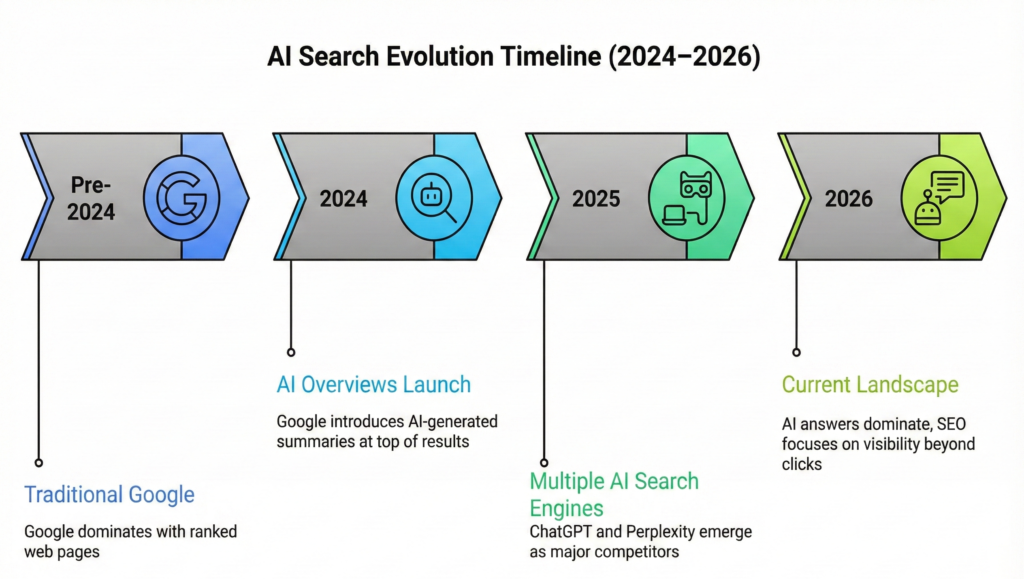
Search as we knew it is over. In 2024, Google rolled out AI Overviews to billions of queries. By early 2026, ChatGPT processes 2.5 billion queries daily, Perplexity handles around 60–70 million, and traditional search results now compete with AI-generated answers at the top of every page.
So, SEO in 2026 behaves very differently, even though it looks familiar.
Search engines haven’t stopped ranking pages, but they increasingly answer questions themselves. AI Overviews, conversational search, and voice interfaces now understand intent before users ever click a link. For agencies, this has created a new challenge: how do you stay visible when search results don’t always send traffic?
The agencies that remain competitive aren’t fighting AI. They’re engineering for it. In this blog, we look at how AI is reshaping SEO in 2026 and the strategies agencies must use to stay relevant and trusted.
AI in Search: What’s Changing in 2026
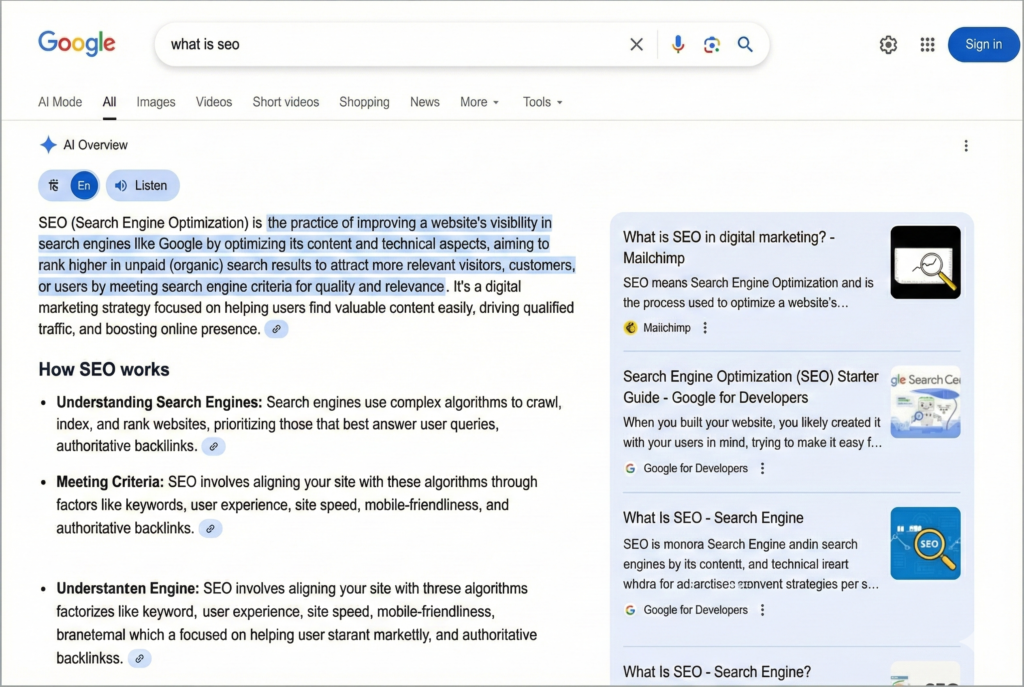
Search engines are becoming answer engines
Google’s AI Overviews, Microsoft Copilot, and conversational search interfaces like ChatGPT now synthesize answers directly in SERPs.
According to SparkToro, over 58% of Google searches in the U.S. already end without a click. And AI Overviews are accelerating this trend.
SEO success is no longer just about traffic. It’s about being cited, referenced, and trusted by AI systems.
Conversational and voice search is no longer niche
Over 50% of U.S. users use voice search daily. Queries are longer, more contextual, and intent-heavy.
Thus, content must answer why and how, not just what. This heavily favors agencies that structure content around natural language and clear answers.
Entities and structured data matter more than keywords
AI models rely on:
- Entity relationships (people, places, things, concepts, or ideas that Google recognizes and understands relationships between)
- Topic clusters
- Schema and structured context
- Consistent brand and author signals
Agencies optimizing only for keywords are already behind.
8 AI SEO Trends in 2026 Every Agency Should Know
1. AI-only content is actively devalued
Google has sophisticated systems to identify purely AI-generated content. Although it doesn’t penalize AI, it penalizes low-effort, low-signal content which pure AI usually produces.
The better formula is to use AI for speed, and humans for judgment and credibility. Include real examples, real opinions, and real edits.
This is where good agencies differentiate.
2. Multimodal search is mandatory
AI now understands images, videos, audio, and text together. Ignoring visual and video SEO now leaves traffic on the table.
Optimization now includes image SEO (Google Lens-ready), video transcripts and schema, and audio/podcast indexing.
3. Real-time SEO over monthly reports
SERPs now change daily, sometimes hourly. AI enables continuous monitoring and predictive impact modeling. Agencies that offer “always-on SEO” over monthly reports are outperforming those still sending PDFs.
4. Programmatic SEO (done carefully)
AI helps to scale, but only with real value per page. Programmatic SEO helps to systematically generate unique, valuable pages targeting long-tail keywords using templates and data. But, each page must offer unique value.
Successful programmatic SEO includes creating content with unique data inputs, contextual variation, and intent-specific usefulness.
Creating a large number of thin pages is failing faster than ever.
5. Predictive SEO is replacing guesswork
AI can forecast ranking probability and traffic. Smart agencies now prioritize high-ranking probability content, not just generic keywords.
6. Personalized SERPs killed universal rankings
There is no single “#1 ranking” anymore. SEO must account for location, device, intent and behavior. Measurement strategies must evolve. And agencies must optimize for personas, not positions.
7. Semantic search rewards natural writing
AI understands context, not keyword density. The best SEO content in 2026 reads naturally, covers topics comprehensively, answers real questions, and avoids forced keywords. First-hand experience signals matter more with E-E-A-T evolution.
8. AI-driven competitor intelligence
Tracking 5 competitors monthly is obsolete. AI monitors competitors continuously. AI can track 50+ competitors, content velocity, backlink patterns, and strategy shifts. This requires agencies to see strategy shifts instantly, react in hours, and anticipate moves before rankings change.
Also Read: White-Label vs Freelancers vs In-House SEO: Cost Comparison
AI SEO Strategies for Agencies in 2026
AI SEO trends are pushing agencies to rethink workflows, not just tools. Below are some of the strategies winning agencies are actually employing.
Strategy 1 – AI-Assisted Content Creation
Winning agencies use AI to analyze SERP intent patterns, identify gaps competitors miss, and structure content hierarchies. They don’t publish AI content blindly. Humans still own insight and narrative.
The Proven Workflow You Can Follow
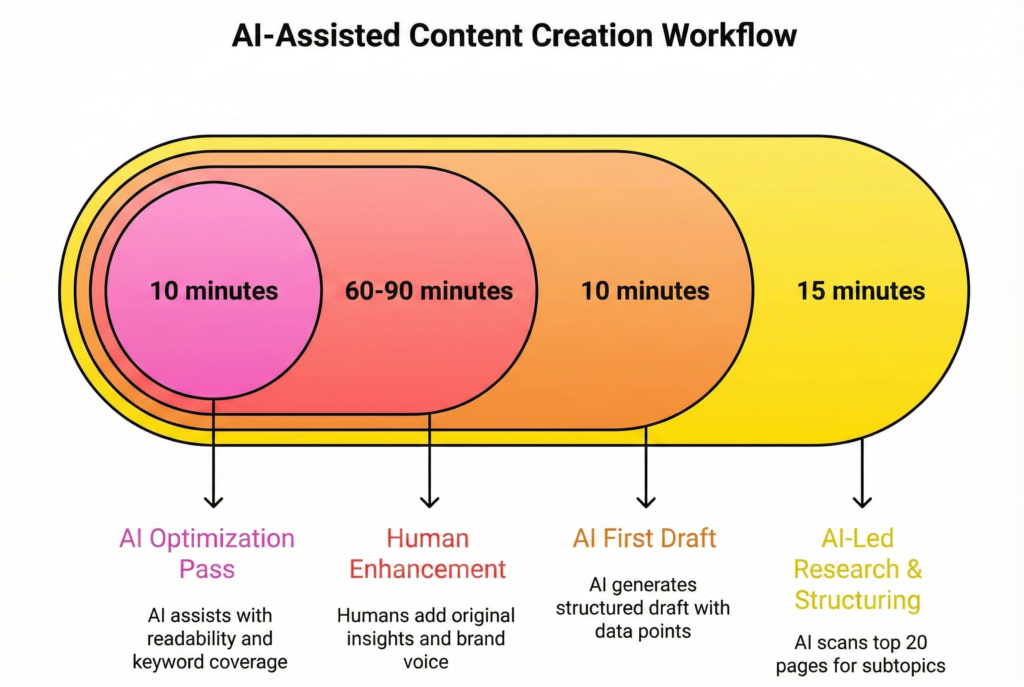
Step 1: AI-Led Research & Structuring (15 minutes)
AI scans the top 20 ranking pages to:
- Identify dominant subtopics and SERP patterns.
- Extract common questions and intent signals.
- Surface gaps that competitors failed to address.
- Produce a logically structured outline.
This replaces hours of manual SERP analysis.
Step 2: AI First Draft (10 minutes)
AI generates a structured draft that covers required subtopics, includes data points and references, and maintains conversational flow. This is a working draft, not a final asset.
Step 3: Human Enhancement (60–90 minutes)
This is where rankings are won.
Here’s what humans do:
- Add original insights and opinions.
- Inject brand voice and positioning.
- Include real examples, use cases, or client scenarios.
- Validate every factual claim.
- Strengthen E-E-A-T signals (author credibility, citations, experience).
- Optimize for decision-level intent, not keywords.
Step 4: AI Optimization Pass (10 minutes)
AI finally assists with:
- Readability and clarity improvements
- Semantic keyword coverage
- Title and meta optimization
- Internal linking recommendations
With this strategy, agencies can easily reduce production time by half. This gives significantly higher quality than AI-only content. And the content ranks organically and gets cited by AI Overviews.
This is the difference between “AI content” and AI-enabled SEO.
Common tools you can use: ChatGPT/Claude/Gemini, Surfer or Clearscope, GrammarlyAI detectors are secondary. Quality and usefulness matter more.
Strategy 2 – Real-Time SEO Audits & Alerts
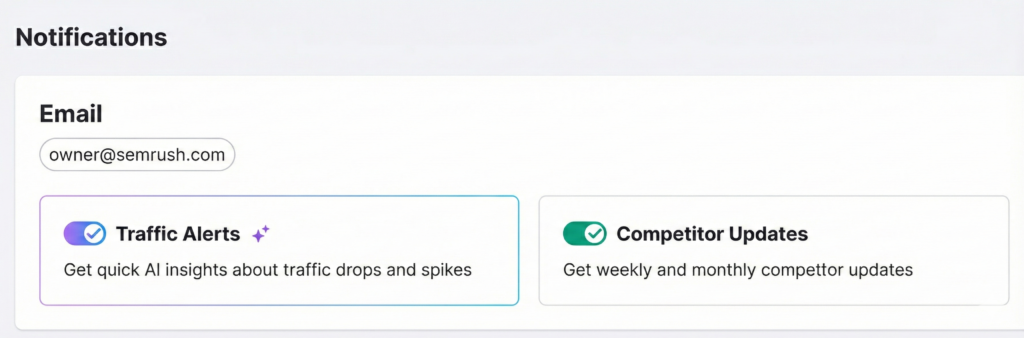
In 2026, SEO problems surface and compound within hours, not weeks. Instead of monthly or quarterly audits, agencies must deploy continuous crawl monitoring, indexation alerts, and ranking volatility detection. When an issue appears, AI helps diagnose the cause, prioritize, recommend fixes with execution steps, predict recovery likelihood, and track post-fix outcomes.
This reduces reaction time, which is critical in AI-driven SERPs. And clients don’t see problems because you fix them before impact.
Typical tools: Ahrefs Alerts, GSC APIs, Screaming Frog Cloud, SEMrush Sensor
Strategy 3 – Entity Optimization for AI Search Engines
AI search prioritizes recognized entities. AI systems trust the brands they understand, authors they recognize, and topics with clear authority signals. Entity strength now directly influences AI Overview citations, conversational answers, and cross-query visibility.
Entity-first SEO includes brand entity clarity, author credibility signals, internal entity linking, and schema alignment. This increases the chances of content being referenced inside AI answers.
Here’s the entity optimization framework you can use:
1. Brand Entity Foundation
- Verified business profiles
- Knowledge base listings (Wikidata, Crunchbase)
- Consistent NAP across the web
- Organization schema implementation
2. Author Entity Development
- Detailed author bios with credentials
- External publishing and mentions
- Linked social profiles
- Clear author attribution across content
3. Topic Entity Coverage
- Map entities connected to your niche
- Build content hubs around each
- Strong internal linking between related concepts
- Earn citations from authoritative sources
4. Entity Relationship Signals
- Natural mentions of industry peers, tools, concepts
- Co-citations and brand mentions
- Contextual association across the web
Strategy 4 – Predictive SEO & Competitor AI Scoring
Leading agencies predict outcomes before investing effort. AI models can:
- Predict ranking shifts
- Model competitor content velocity
- Identify declining topics before traffic drops
With these insights, you can target weak competitor zones first and avoid unwinnable battles. You can also identify ignored adjacent topics and anticipate competitor moves early.
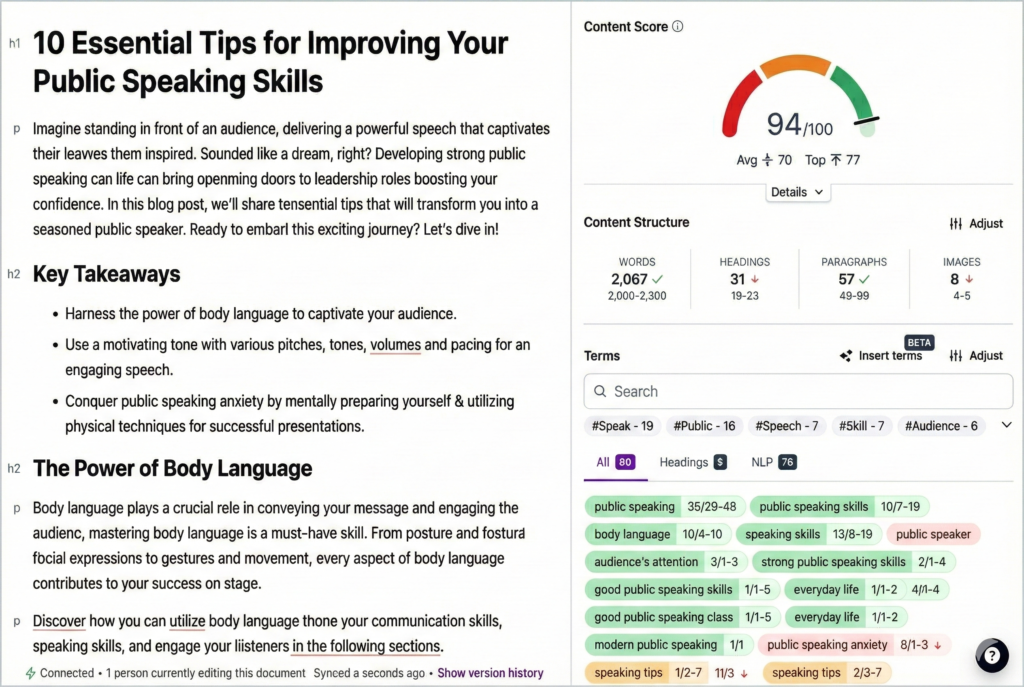
Tools to use:
- MarketMuse for content intelligence
- Clearscope/Surfer for content scoring
- Ahrefs for competitor gap analysis
- Custom AI models (ChatGPT, Claude) for pattern recognition
Strategy 5 – Voice and Visual Search Alignment
AI-powered search increasingly blends voice responses, image recognition, and multimodal results. And AI processes all formats equally. That’s why you should optimize for both voice and visual search.
Voice Search Optimization
- Conversational writing
- Question-based content
- Clear, concise answers (≈30 words)
- Strong featured snippet targeting
- Local SEO optimization for “near me” intent
Visual Search Optimization
Images
- Original, high-quality visuals
- Descriptive filenames and alt text
- Image schema and sitemaps
Video
- Transcripts and captions
- Video schema
- Structured chapters
- Click-worthy thumbnails
AI pulls answers from any format it understands.
Strategy 6 – Human Editing + AI Efficiency = Best Results
This model is not AI vs humans. It’s AI removing friction so humans focus on leverage. AI accelerates drafts. Humans ensure accuracy, tone, trust, and differentiation.
What AI Should Handle
- Research and drafting
- Data analysis
- Technical audits
- Keyword discovery
- Monitoring and alerts
- Repetitive optimization tasks
What Humans Must Control
- Strategy and prioritization
- Original thinking
- Brand voice
- E-E-A-T signals
- Quality control
- Client communication
The Winning Formula: AI handles 70% of execution (research, drafting, analysis, monitoring). Humans handle 30% of high-value work (strategy, creativity, relationships, final polish).
AI SEO in 2026 — Tools Agencies Should Use
Below is a practical, non-bloated AI SEO stack used by competitive agencies.
AI Keyword Research and Topic Discovery Tools
- SEMrush: Intent clustering, SERP patterns
- Ahrefs: Gap analysis, traffic forecasting
- AlsoAsked/AnswerThePublic: Conversational & FAQ mapping
Also Read: Best Free SEO Tools for 2025: Keyword, Audit & Ranking
AI Content Optimization Tools
- Surfer SEO/Clearscope: Semantic coverage
- MarketMuse: Topical authority modeling
- Frase: Briefing and optimization workflows
AI Technical SEO Audit Tools
- Screaming Frog (Cloud): Scalable audits
- Sitebulb: Client-friendly diagnostics
- Google Search Console: Anomaly detection
AI Content Creation Tools
- ChatGPT/Claude: Drafting and synthesis
- Jasper/Copy.ai: Short-form and ads
AI Competitor Intelligence Tools
- SpyFu/BuzzSumo/Similarweb: Competitor monitoring
Traditional SEO Agency vs AI-Integrated SEO Agency
| Factor | Traditional Agency | AI-Integrated Agency |
| Content production | ~10 blogs/month | 40+ blogs/month |
| Keyword research | 8–10 hrs | 1–2 hrs |
| Technical audits | 15–20 hrs | 2–4 hrs |
| Prediction accuracy | 60–70% | 85–95% |
| Content consistency | Writer-dependent | AI + human controlled |
| Cost per client | $5k–$10k/mo | $2k–$4k/mo |
| Scalability | Linear | Exponential |
| Reporting | Monthly, manual | Real-time dashboards |
| Competitive monitoring | 5–10 competitors | 50+ competitors |
| Response time | Days/weeks | Hours |
| Profit margins | 20–35% | 45–65% |
| Future readiness | Declining | Compounding advantage |
Future of AI SEO Trends (What’s Coming Next)
AI continues to penetrate further into search and SEO. This is expected to bring shifts that will redefine how agencies operate, price, and compete over the next 24–36 months. Some of these will arrive faster than expected. Others will separate scalable agencies from service businesses.
Here are some of the expected future AI SEO trends that agencies must prepare for:
- AI agents that don’t just recommend but execute.
- Deeper entity trust scoring.
- Quantum computers analyze entire website ecosystems in seconds.
- Increased emphasis on experience-led content (Google may prioritize blockchain-verified content for E-E-A-T signals, especially in YMYL niches.)
- Real-time content adaptation.
- Higher penalties for low-value automation.
Most importantly, SEO will reward usefulness and systems, not hacks.
Conclusion
AI didn’t simplify SEO. It raised the cost of being average.
As AI penetrates further into search, clients expect faster results and clearer reporting. Procurement teams demand process transparency. And SMBs want predictable outcomes, not experimentation.
In 2026, agencies that stay competitive are those that treat AI as infrastructure, not a shortcut. Human judgment, strong systems, and disciplined execution remain the real differentiators.
Agencies that combine AI-driven speed, human-led strategy, and structured delivery systems will outperform those relying on either alone.
This is why many agencies quietly adopt white-label SEO execution partners, keeping strategic control while scaling operations responsibly.
Ready to see what AI-augmented SEO can do for your agency? Let’s talk.
FAQs
How is AI in search changing SEO in 2026?
Search engines increasingly answer queries directly, reducing clicks but raising the bar for authority. Also, search is no longer Google-only as platforms like ChatGPT, Perplexity, and other AI answer engines are common among users. SEO now optimizes for entities, intent, and authority; not keywords alone.
What are the top AI SEO trends agencies should follow?
The biggest trends include:
- AI-assisted content with mandatory human oversight
- Real-time SEO monitoring instead of monthly reviews
- Entity-first optimization over keyword-first SEO
- Multimodal search (text, image, video, voice)
- Predictive SEO that estimates ranking potential before publishing
Will AI replace SEO professionals?
No. It replaces repetitive tasks, not strategy. AI handles research, drafting, audits, and monitoring. Humans provide expertise, originality, judgment, and accountability. The winning model is hybrid, not completely automated.
What are the best AI SEO strategies for agencies?
The best strategies are the ones tied to outcomes. These include:
- AI for research and first drafts, humans for insight and accuracy
- Content built around entities and intent, not just keywords
- Predictive opportunity scoring before content goes live
- Always-on monitoring with fast corrective action
How can agencies stay competitive using AI tools?
By building systems. Top agencies use a small set of tools across research, content, optimization, monitoring, and reporting. Then they layer human judgment on top. Tools enable scale; strategy creates differentiation.
How does AI improve content creation?
It accelerates drafts and analysis. Humans ensure quality. AI improves speed, structure, and consistency. Humans add experience, credibility, and original perspective. AI-only content is fast but forgettable and risky.
Is AI SEO different in the USA vs other regions?
Yes. Zero-click searches and AI Overviews are more prevalent in the U.S. US SEO is also more competitive, more voice-driven, and more AI-aware. Clients expect transparency around AI usage, faster execution, and stronger authority signals, especially in SaaS, tech, and local search.
What tools help with AI SEO in 2026?
Most agencies succeed with:
- SEMrush or Ahrefs (research)
- Surfer or Clearscope (optimization)
- ChatGPT or Claude (drafting)
- Screaming Frog or Sitebulb (technical)
- GA4 & Looker Studio (reporting)
The edge comes from how you use them, not how many you buy.