


A B2B SaaS brand needs more than a hundred pieces of content – comparison pages, use case guides, integration walkthroughs, help documentation, and so on. Unlike an e-commerce company, their buyer doesn’t wake up one morning, find the site, and purchase. Their buyer researches for 3–9 months, loops in 6–10 colleagues, disappears for a while, comes back, compares 3 other tools, and then, maybe, signs up for a trial.
Traditional SEO funnels were not built for this. They were built for linear journeys, and this isn’t one.
This is why companies like HubSpot, Atlassian, and Salesforce stopped thinking in funnels a long time ago.
The model they switched to is called the content flywheel: a self-reinforcing system in which each piece of content (customer success story, help article, and integration guide) attracts more prospects, who become customers and create more content fuel for attracting the next round of prospects.
The difference? Funnels leak. Flywheels compound.
So, if you’re a B2B company, here’s how you can build content flywheels and compound growth.
TL;DR
- Content flywheels generate compounding returns while traditional funnels require constant input.
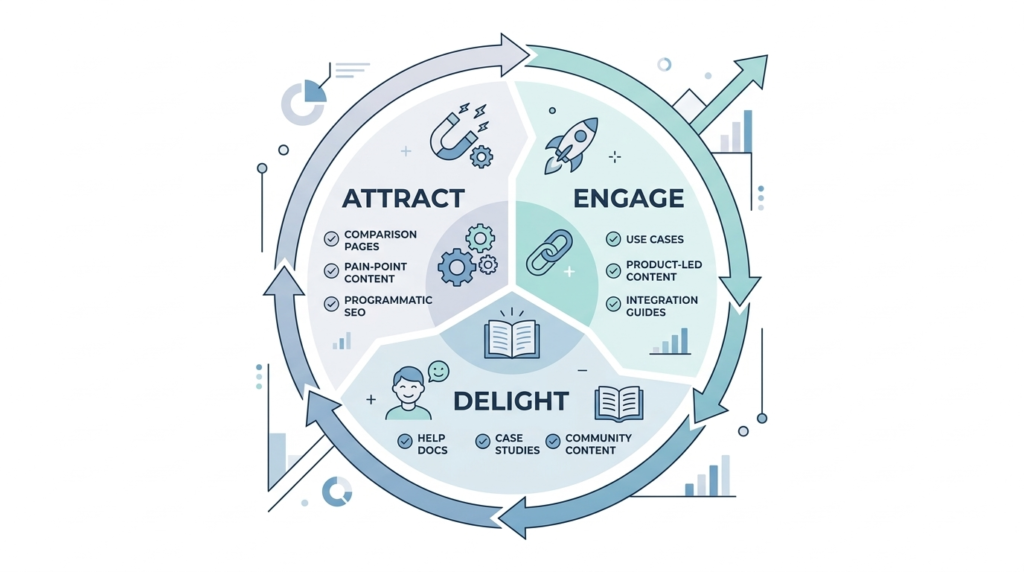
- Structure content into 3 stages:
Attract: comparison pages, pain-point content, programmatic SEO
Engage: product-led content, use cases, integration guides
Delight: help docs, community content, case studies- Customers fuel growth via reviews, backlinks, and referrals.
- Focus on systems, not isolated content pieces (strong internal linking + structure).
- Execute with programmatic SEO, regular content refreshes, and “jobs to be done” content clusters.
- Measure success using SaaS metrics (MRR, CAC), not just traffic.
- White-label SaaS SEO partnerships enable flywheel execution at scale.
The Fatal Flaw in Traditional SEO Funnels
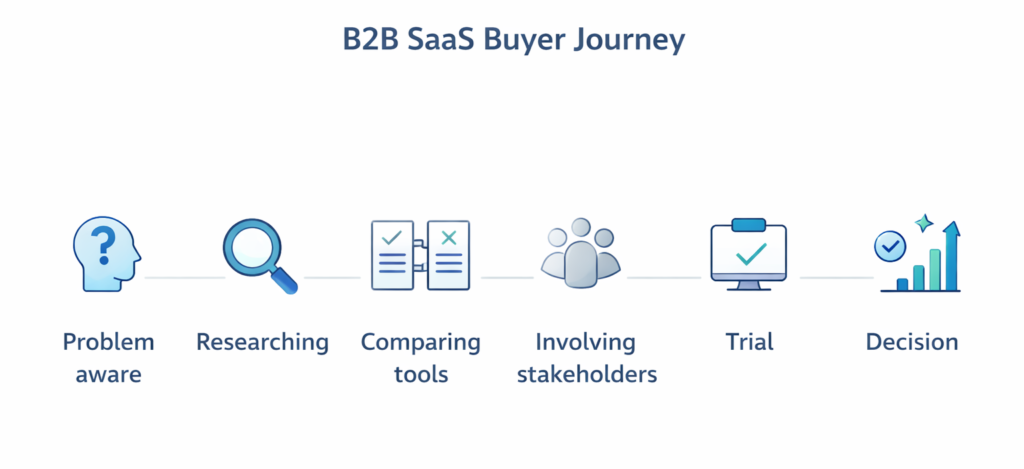
To understand why the flywheel works, you first have to understand why the funnel doesn’t.
The traditional funnel model moves linearly: Awareness → Interest → Consideration → Decision → Purchase. Clean on a whiteboard. Completely mismatched to how B2B software actually gets bought.
The problem arises because of the assumptions baked into it. It assumes a single decision maker. It assumes the journey moves in one direction. It assumes the job is done at purchase. And it requires constant input: stop creating content, and the funnel empties immediately. Nothing compounds. You start over every month.
Here’s what that looks like in practice. A traditional funnel creates awareness content. A thousand visitors arrive. A hundred become leads. Ten start trials. One becomes a customer. Next month, same effort, same result. No acceleration. No memory.
The other problem is where the funnel ends. It ends at purchase – right at the moment when the customer relationship actually starts to generate value. Every referral, testimonial, case study, community post, and organic backlink that a happy customer produces is invisible to funnel thinking. It’s not measured, not invested in, not designed for. That’s a lot of growth left on the table.
The Content Flywheel Shift
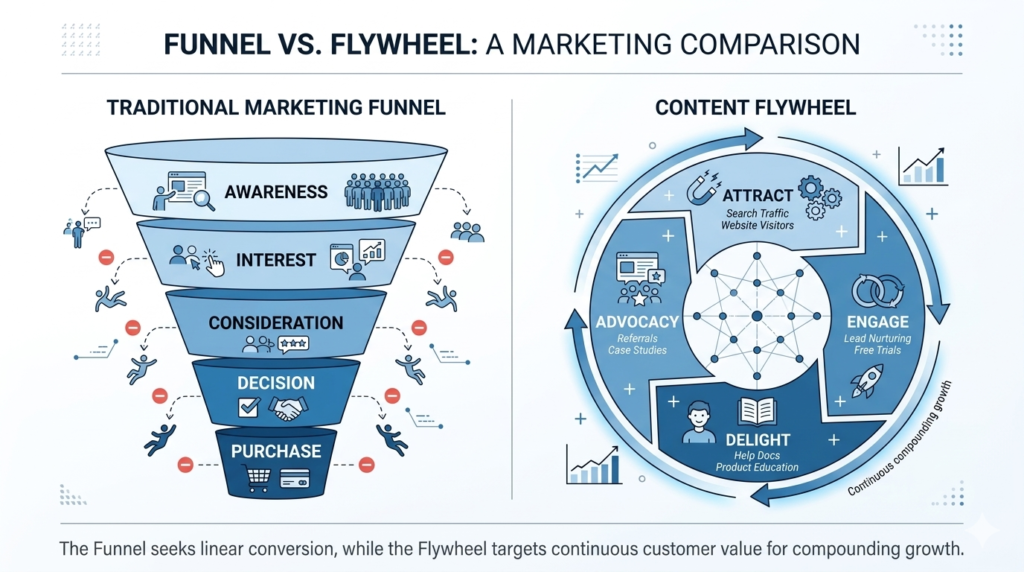
HubSpot pioneered the flywheel model by recognizing something the funnel missed entirely: customers are not the end of the acquisition story. They’re the fuel for the next chapter of it.
The flywheel runs on three phases: Attract, Engage, Delight. Each feeds the next. And the third feeds back into the first.
Why B2B SaaS Companies are Shifting to the Flywheel Model:
- Self-reinforcing: Happy customers create testimonials, case studies, and referrals.
- Compounding returns: Each content piece attracts visitors indefinitely.
- Customer-centric: Focus on delight creates organic advocacy.
- Efficient: Resources invested in customer success generate ongoing acquisition value.
- Accelerating momentum: System speeds up over time rather than requiring constant restarts.
Example: Create help documentation → Attracts problem-solvers via search → Converts to customers → Customers share solutions in communities → More organic searches → Accelerating growth without proportional content investment.
Also Read: AI & SEO in 2026: How Agencies Can Stay Competitive (Guide)
The Content Flywheel Framework for B2B SaaS SEO
Phase 1: Attract (The Outer Rim)
The goal here is high-intent traffic from prospects who are already aware they have a problem and are actively looking for solutions.
Content Types:
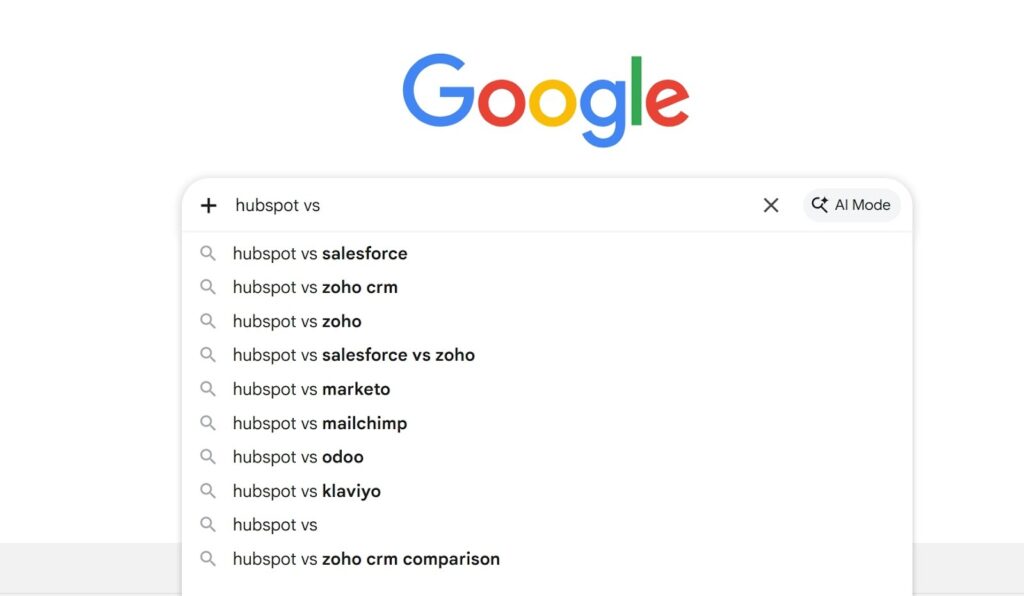
1. Comparison Pages:
The content that works best in the Attract phase is comparison pages. They capture prospects at the exact moment they’re evaluating options. These people aren’t browsing; they’re buying. Conversion rates on well-built comparison pages can be 4–8%, compared to 1–3% for top-of-funnel content.
Examples:
- [Your SaaS tool] vs [Competitor]
- Best [Competitor] Alternatives
2. Pain-Point Cluster Content:
Pain-point cluster content sits alongside comparison pages in the Attract phase. They target early-stage researchers who know they have a problem but haven’t settled on a solution category yet. High search volume, strong topical authority signal, and a natural bridge to your product.
Examples:
- How to [solve specific problem]
- [Industry] challenges and solutions
3. Programmatic Landing Pages:
This is where SaaS separates from everything else. The idea is to create a template, say “[Your CRM] for [Industry],” and generate 50 or 100 variations: CRM for real estate, CRM for insurance, CRM for nonprofits. Each page gets unique content – industry-specific pain points, relevant integrations, and use cases that actually apply.
Done well, programmatic SEO captures thousands of long-tail searches that would be impossible to target manually. Done poorly, with thin content that just swaps a variable, it creates duplicate content disasters and Google penalties. The execution gap between those two outcomes is significant, and we’ll come back to it.
Examples:
- “CRM for [industry]” (50+ industry variations)
- “[Tool] integrations” (100+ integration pages)
Phase 2: Engage (The Spokes)
You’ve attracted a prospect. Now the goal is to deepen the relationship through content that lets them experience the product before they’ve paid for it.
Content Types:
1. Product-Led Content:
Product-led content is the defining format in this stage. This isn’t a blog post that mentions your product in a callout box. The ones that work are:
- Interactive demos embedded in articles
- Calculators and assessment tools (that use your product’s actual logic)
- Template libraries users can copy straight into your product.
Time-on-page for this type of content can be more than 50% higher than static content.
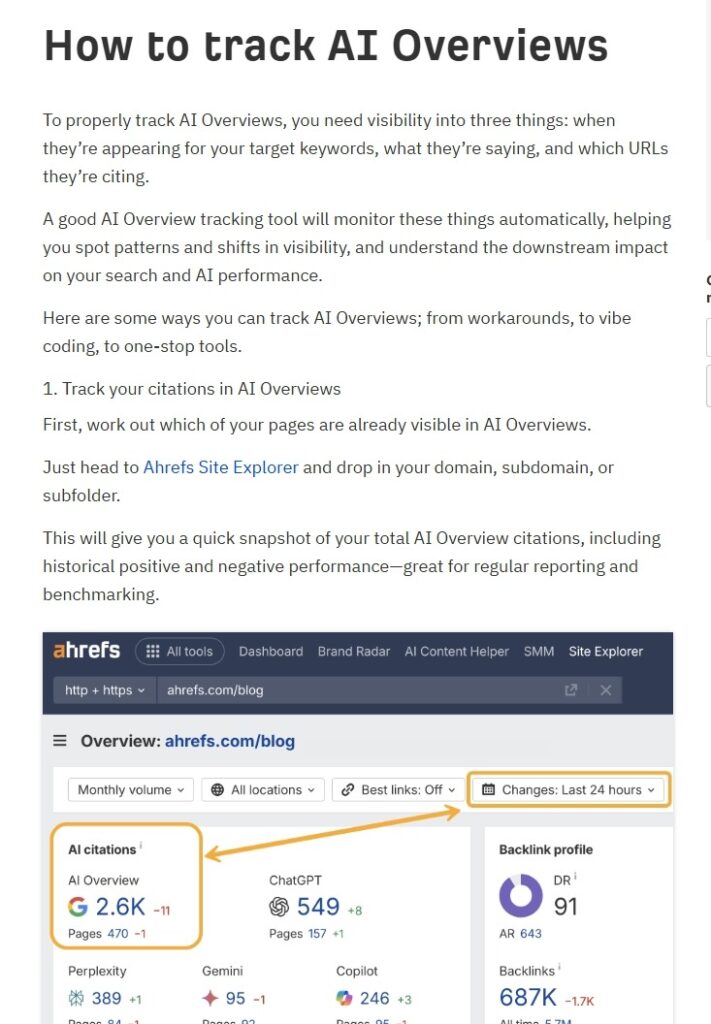
Ahrefs does this particularly well. Their SEO guides include live data pulled from their own tool. Users interact with actual product functionality while learning, experiencing product value before trial signup.
2. Use Case Deep Dives:
Use case deep dives live here, too. Examples include:
- “[Role] guide to [achieving outcome]”
- Industry-specific playbooks
- Step-by-step tutorials with screenshots
These convert at 2–3 times the rate of generic awareness content because they speak directly to the job a specific person is trying to get done.
3. Integration Guides:
Integration guides are the quiet workhorses of the Engage phase. “How to connect [Your SaaS Product] with [Popular Tool]” targets users who are already committed to a tech stack and looking to extend it. This content doesn’t just attract; it reduces churn by increasing the perceived cost of switching, because a well-documented integration makes your tool feel embedded rather than optional.
Strategic Internal Linking
The internal linking structure connecting these three content types matters enormously. Attract content leads to Engage content, which leads to product pages. The path from “project management challenges” to “agile workflow guide” to “start free trial” should be frictionless and deliberate.
Phase 3: Delight (The Hub)
This is where most marketing agencies don’t build anything at all, because help documentation doesn’t feel like SEO. That’s a mistake, especially for SaaS brands. When done right, the Delight phase creates customer advocates who fuel future attraction.
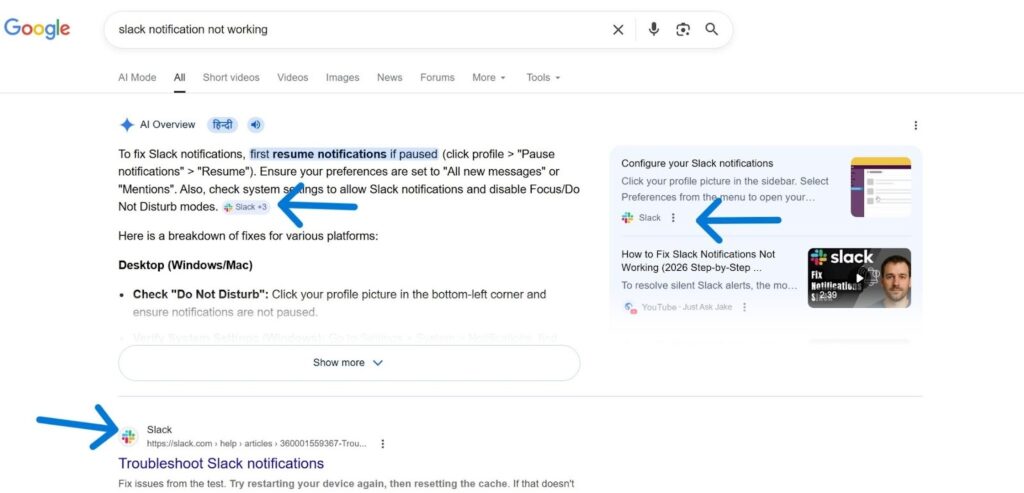
Slack’s help center ranks for thousands of keywords. Every article in it solves a customer problem and simultaneously attracts a new prospect searching for the same solution. That’s the flywheel in action: better help content makes customers happier, happier customers advocate in communities, community advocacy creates backlinks and brand searches, brand searches increase domain authority, and higher authority improves rankings across the entire site.
Content Types:
1. Comprehensive Help Documentation:
Includes:
- Searchable knowledge base
- Video tutorials
- Troubleshooting guides
2. Community-Generated Content
User-generated content creates thousands of indexed pages with fresh, keyword-rich material without any direct production cost. Examples include:
- User forums
- Feature request boards
- Customer success stories
3. Customer Case Studies
Customer case studies do double duty: they convert prospects reading them, and they delight the featured customers who share them widely. Case studies must include:
- Detailed success stories with metrics
- Industry-specific applications
- Quoted testimonials
Advanced Documentation That Ranks
The advanced version of this phase is optimizing help documentation specifically for search. Queries like “how to [specific feature action]” and “[error message] troubleshooting” are bottom-funnel, often face zero competition, and convert immediately because the person searching is already a user or an active evaluator. Most brands never touch this. The ones that do build an enormous moat.
Also Read: Best Free SEO Tools for 2025: Keyword, Audit & Ranking
Executing the B2B SaaS SEO Strategy as an Agency: Three Tactics That Actually Move Numbers
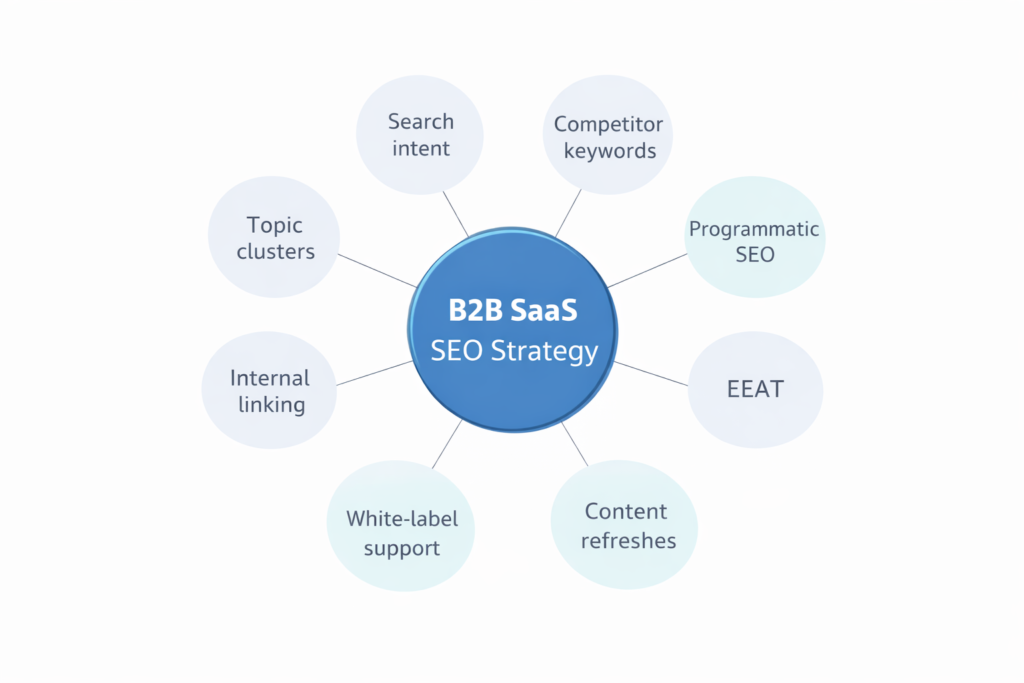
Understanding the flywheel model is one thing. Building it for a client is another. Here are the 3 execution tactics that separate the agencies doing this well from the ones still producing generic content calendars.
Tactic 1: Programmatic SEO for Scale
I mentioned this above, but the execution detail matters. Template-based page generation requires more than a developer spinning up a CMS template. Each page needs unique content that reflects the actual use case: real pain points for that industry, relevant integrations, and specific examples. It needs dynamic schema markup. It needs a QA process that catches thin content before it gets indexed.
The infrastructure to do this safely (development resources, copywriting systems, quality assurance) is substantial. Agencies that try to shortcut it with variable swapping end up with a penalty. On the other hand, white label SaaS SEO providers have built this infrastructure to execute it safely at scale.
Also Read: 11 SEO-Friendly URL Best Practices for Higher Rankings
Tactic 2: Quarterly Content Refreshes
Google’s freshness algorithm rewards recently updated content for time-sensitive queries, and SaaS content goes stale faster than most. You need to refresh content based on data.
The refresh cadence varies by content type:
- Product pages: Update monthly (feature releases)
- Comparison pages: Update quarterly (competitor changes)
- Evergreen guides: Update every 6-12 months
- Pricing pages: Update immediately when pricing changes
The smart prioritization is data-driven: refresh pages with declining traffic first (to avoid freshness penalty), then pages sitting at positions 5–15 (a refresh can push them to page 1), then high-conversion pages where even a small improvement compounds over time.
Tactic 3: “Jobs to Be Done” Content Clusters
This is a framework shift that changes how you organize an entire content strategy. Instead of building content around product features (“our dashboard,” or “how to use our reporting tool”), you build content around the jobs users are trying to accomplish. For example, “How to prove marketing ROI to executives,” “Automate weekly performance reports,” “Compare campaign performance across channels.”
Each job gets 5-10 supporting articles covering:
- Why this job matters
- Common approaches and limitations
- How [Your SaaS product] solves it
- Step-by-step tutorial
- Advanced use cases
The SEO benefit is real: you’re capturing the entire decision journey for each job, which builds comprehensive topical authority in a way that feature-based content never can.
Also Read: White-Label Integration Playbook for Agencies (First 90 Days)
Why Agencies Need a White-Label SaaS SEO Partner
There are three major challenges in executing the content flywheel strategy that consistently break generalist agencies. Not because they lack intelligence or effort, but because SaaS SEO requires capabilities that aren’t part of the standard SEO toolkit.
The Technical Complexity Problem
B2B SaaS products are overwhelmingly built on modern JavaScript frameworks like React, Vue.js, and Angular. Many are single-page applications. Traditional SEO audits weren’t designed for these architectures. Generic SEO recommendations applied to a React-based SaaS product will often break functionality, miss indexing issues entirely, or recommend changes that engineering will reject outright.
The right technical approach requires understanding client-side versus server-side rendering, SPA indexing challenges, dynamic content generation, and API-driven content systems. This isn’t knowledge you can download in a weekend.
Partnering with a white-label SEO agency provides you with specialists who understand modern tech stacks, work with engineering teams, and implement solutions that don’t compromise user experience.
The Content Velocity Problem
Top-performing SaaS companies publish 16-20+ pieces monthly: 4-6 comparison pages, 4-6 use case guides, 4-6 help documentation updates, 2-4 thought leadership pieces, and more. Sustaining that volume requires subject matter experts who understand SaaS deeply, writers with hands-on product experience, technical writing skills, and SEO optimization layered on top.
Building this in-house costs $180,000–$280,000 per year for two to three full-time specialists. A white-label SaaS SEO partner runs $3,000–$6,000 per month ($36,000–$72,000 annually) while maintaining the same quality and velocity. The savings: $108,000–$208,000 per year, per client.
The SaaS Metrics Fluency Problem
SaaS executives don’t care about rankings. They care about metrics like:
- MRR (Monthly Recurring Revenue) from organic
- CAC (Customer Acquisition Cost) via SEO
- LTV:CAC ratio by channel
- Trial-to-paid conversion by landing page
- Logo churn rate by acquisition source
Generic agencies report on traffic and rankings, hand over the report, and wonder why the client seems unimpressed. A white-label partner fluent in SaaS economics connects every SEO action to the revenue metrics the client is actually managing. That’s what retains the relationship.
Don’t Suffer from Content “Scatterload”
Agencies attempting SaaS content strategy without flywheel thinking tend to end up with a pile of disconnected assets: a few blog posts here, a comparison page someone requested, a help article that never got optimized. It looks like content. It doesn’t function like a system.
Content without architecture isn’t a flywheel; it’s just weight. And it won’t compound no matter how much of it you produce.
If you’re serious about serving B2B SaaS SEO clients at scale, the math is similar to every other specialized vertical: building the capability yourself costs far more than partnering with someone who already has it. And when your agency grows from 3 SaaS clients to 15, the partner model scales without proportional cost: same infrastructure, volume discounts, no additional hiring. The in-house model at 15 clients requires expanding the team proportionally, with all the management complexity that comes with it.
Also Read: White-Label vs Freelancers vs In-House SEO: Cost Comparison
Vetting Your White Label SaaS SEO Partner
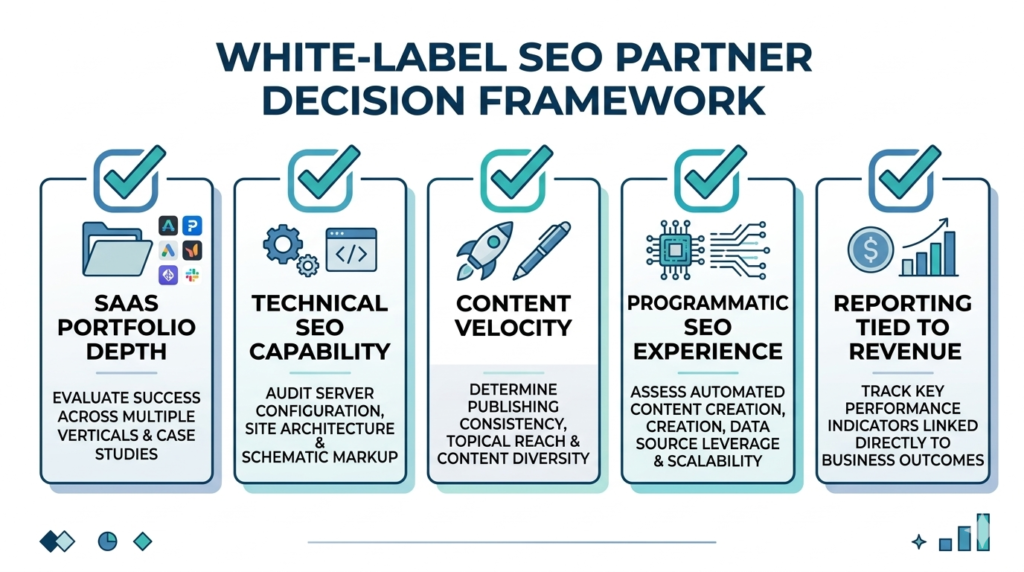
The flywheel principle applies to your agency, too. The right partnership adds momentum without adding proportional weight.
If you’re considering partnering with a white label SaaS SEO provider, here’s how to find out whether they really understand SaaS before you commit a client to them:
- SaaS portfolio depth: Ask for 3 or more B2B SaaS clients they’ve worked with and the ARR growth results they drove. Not traffic charts. Red flag: they show you B2C e-commerce or local business examples and call it SEO experience.
- Technical stack capabilities: Ask specifically how they handle JavaScript rendering and SPA indexing. If they don’t immediately understand the question, or suggest techniques that were standard practice 4 years ago, that’s the answer.
- Content production systems: Ask how they maintain velocity at 20 or more pieces monthly while maintaining quality. They should have a documented workflow, not a vague answer about their network of freelancers. Red flag: no QA process, no documented production system, no clear answer about who is responsible for accuracy.
- Programmatic SEO experience: Ask for a specific example of a programmatic implementation they’ve executed and how they avoided thin content penalties. They should be able to walk you through the content differentiation strategy, the schema implementation, and the QA process. Red flag: no programmatic examples, or a suggestion that variable swapping is sufficient.
- Reporting sophistication: Ask how they connect organic traffic to MRR and CAC. If the answer involves a rank tracking dashboard and a Google Analytics export, you’re talking to the wrong partner.
Conclusion
B2B SaaS SEO demands moving beyond linear funnel thinking for self-reinforcing flywheel models where customer delight fuels future attraction.
If you haven’t been building content flywheels for your SaaS clients (and most agencies haven’t), here’s a practical checklist to get started:
- Audit your current content for flywheel structure.
- Build your comparison page set first.
- Map your internal linking to the flywheel.
- Identify your programmatic opportunity.
- Set content refresh priorities.
- Build the help documentation layer.
One last thing: never treat the flywheel as a one-time build. Competitor positioning changes. Google’s quality standards evolve. Products release new features. The flywheel needs maintenance (quarterly content audits, regular refresh cycles, ongoing programmatic expansion) or it gradually slows down.
Start building this today, and you’ll find it does something traditional SaaS SEO can’t: the effort you put in this quarter is still paying dividends two years from now.
Want to execute this without an in-house team? Justwords’ white-label SaaS SEO solutions can help. Contact us to learn how.
Also Read: Learn to Build Successful White Label Partnership That Scale
FAQs
1. What is the difference between B2B SaaS SEO and regular SEO?
B2B SaaS SEO differs from traditional SEO because it targets longer, more complex SaaS buyer’s journey stages and multiple B2B stakeholders. It focuses on SEO for SaaS websites, product-led content, and revenue-driven performance. It combines technical SEO, on-page elements, and content strategy to drive organic traffic, improve conversion rates, and support sustainable growth for B2B SaaS businesses.
2. How does a content flywheel differ from a marketing funnel?
A funnel is linear, while a flywheel is a continuous loop where SEO, content marketing, case studies, and SaaS content build momentum. In an effective B2B SaaS SEO strategy, content improves user experience, builds trust in your brand, and drives organic growth by feeding future SEO efforts.
3. What are the most important SEO metrics for B2B SaaS growth?
The most important metrics for B2B SaaS SEO performance include organic traffic, conversion rate, MRR, CAC, and LTV:CAC. Strong SEO performance also tracks content performance, internal linking, and how well SEO drives revenue, not just rankings. These are core to any effective SaaS SEO strategy.
4. How long does B2B SaaS SEO take to show results?
Most SaaS SEO efforts show early traction in 3–4 months as rankings improve. Meaningful organic growth and pipeline impact usually take 6–9 months, while a successful SEO strategy and flywheel-driven growth develop over 12+ months.
5. Can I use a white label SEO provider for SaaS audits?
Yes, but a SaaS SEO agency must understand technical SEO, JavaScript-heavy websites, and indexing challenges. The best B2B SaaS SEO agencies follow best practices, improve user experience, and ensure your product is fully optimized for search.
6. What is programmatic SEO in SaaS?
Programmatic SEO is a key part of SaaS SEO, where you create scalable pages (e.g., “CRM for X industry”). Done right, it follows best practices, uses strong keyword research, and creates unique content that drives organic traffic and supports SEO success.
7. How often should I update SaaS content?
Updating SaaS content is a core SEO best practice. Product pages should be updated monthly, comparison pages quarterly, and evergreen content every 6–12 months. Regular updates improve performance, maintain rankings, and support organic growth.
8. Why are comparison pages important for SaaS SEO?
Comparison pages are critical for B2B SaaS SEO because they target high-intent buyers. They improve conversion rates, support your SEO strategy, and help position your solution against competitors, making them essential for effective SEO.
9. How do white label partnerships help SaaS agencies scale?
White label partnerships help scale SEO efforts by providing expertise in technical SEO and content marketing, which includes SaaS-specific writers and high content output – all without hiring internally. This allows agencies to execute strategies effectively while maintaining quality and driving performance.
10. Is link building still necessary for SaaS SEO?
Yes, link building remains essential for B2B SaaS SEO. Focus on high-quality links from case studies, integrations, and partnerships. Strong link building improves rankings, builds brand trust, and boosts organic traffic for long-term growth.