

TL;DR
- In-house SEO cost looks affordable at first, but the hidden expenses push it far beyond $180K/year.
- Tool subscriptions, hiring, turnover, and slow output quietly shrink your margins.
- White-label SEO gives you the skills of an entire team at a predictable cost.
- White-labelling is ideal for agencies, founders, and brands that want faster results without overhead.
- It’s great if you want SEO output without HR, payroll, software bills, or management stress.
Introduction
Many founders and agencies assume hiring an internal SEO team is cheaper than outsourcing. On paper, a $70K SEO hire does sound cheaper than a $5K/month agency.
But is it really?
Once you calculate salaries, tools, training, and retention costs, the number jumps sharply. What seems like a simple monthly salary becomes a $180K annual expense before you even count inefficiencies or slow output.
Let’s break down what in-house SEO actually costs, including the hidden expenses most agencies miss.
In-House SEO Cost: The Real Breakdown
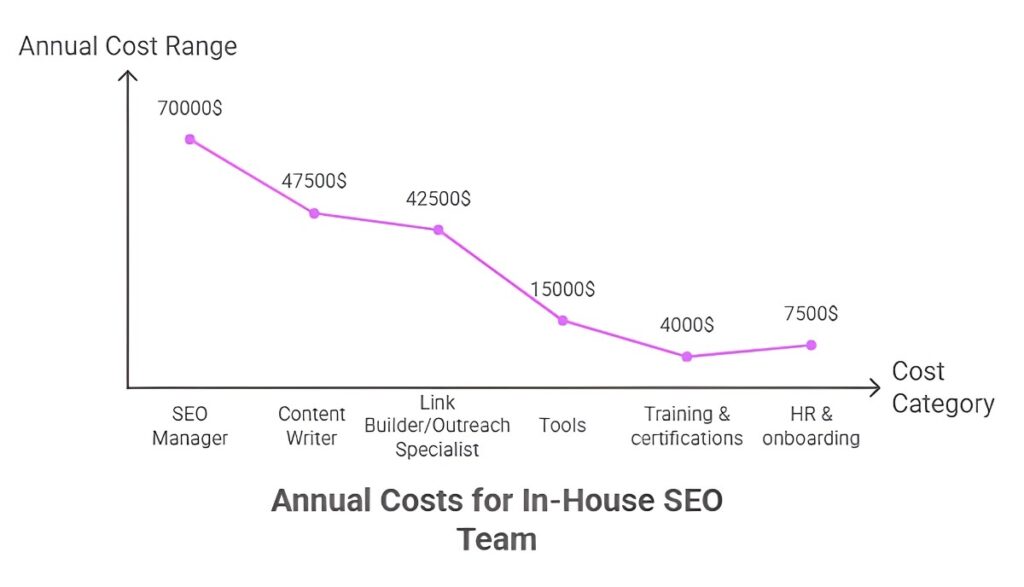
Here’s how the math stacks up for a typical in-house SEO team:
- SEO Manager: $60,000–$80,000 per year
- Content Writer: $40,000–$55,000 per year
- Link Builder/Outreach Specialist: $35,000–$50,000 per year
- Tools: $12,000–$18,000 per year
- Training & certifications: $3,000–$5,000 per year
- HR & onboarding: $5,000–$10,000 per year
According to Ahrefs, most businesses spend $500–$5,000/month on SEO; and 63% fall inside that range. This is the budget most SMBs expect to spend on SEO, usually through outsourcing. In-house SEO pushes costs far beyond this range.
Once you combine salaries, tools and additional overhead, the cost of in-house SEO easily crosses $180k, sometimes even $220k, depending on your market.
What are the Hidden Costs of In-House SEO?
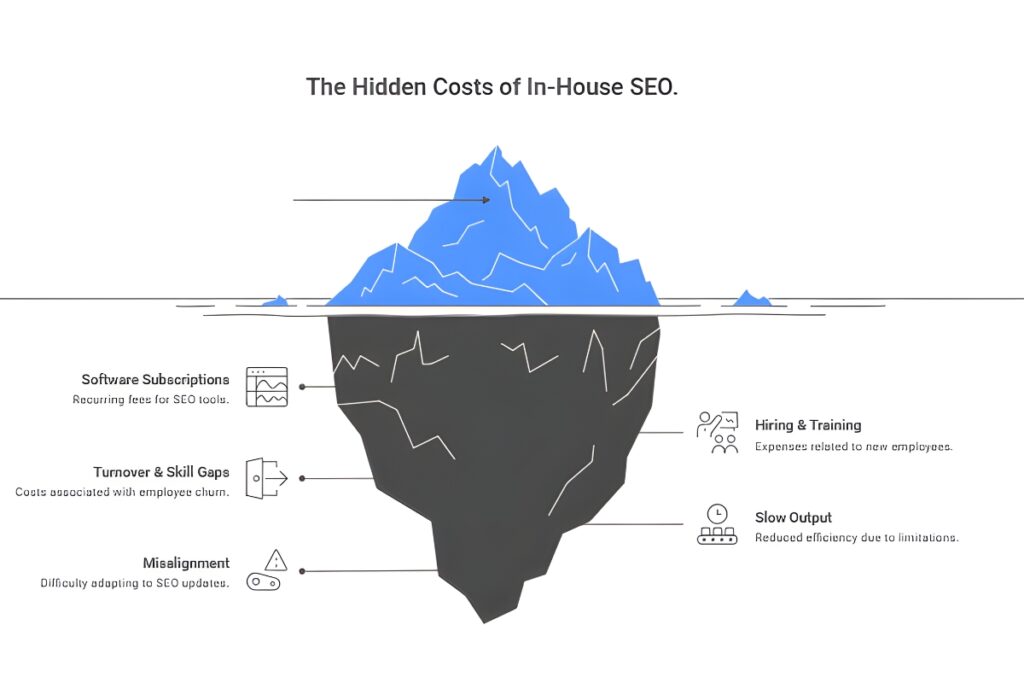
Even with a well-planned budget, most brands underestimate how quickly the expenses pile up. Below are the hidden layers behind the number.
Hidden Cost #1: Software & Tool Subscriptions
SEO runs on specialized tools, and even a basic in-house setup needs multiple platforms to handle research, optimization, tracking, and content workflows.
These subscriptions add up quickly and renew yearly, whether your team uses them fully or not. That makes software one of the most significant silent expenses in the in-house SEO cost.
Required tools usually include:
- Ahrefs or Semrush
- Surfer SEO or Clearscope
- Screaming Frog
- Content workflow systems
- Keyword research databases
- AI writing tools
- Rank tracking tools
Estimated yearly cost:$12,000–$18,000
Hidden Cost #2: Hiring, Onboarding & Training
Recruiting skilled SEO talent in the US is slow, expensive, and competitive. Each new hire requires HR resources, paid listings, assessments, and onboarding time long before they start producing results.
According to SHRM, companies spend an average of $4,700 per hire, a figure often used as the standard benchmark for hiring costs across the U.S.
This hiring cycle repeats every time someone leaves or grows out of the role, making it an ongoing cost.
Hiring expenses typically include:
- Job listing fees
- Hiring agency or recruiter charges
- HR screening hours
- Interview coordination
- Background checks
- Skill tests and trial assignments
Estimated cost per hire: $3,000–$7,000 (excluding onboarding)
Hidden Cost #3: Turnover & Skill Gaps
SEO roles experience high churn because demand is high, and specialists often move for better pay or growth.
Every departure causes knowledge loss, campaign delays, and a full reset of the hiring process. For small teams, even one resignation can stall projects for months.
Key turnover costs:
- Replacement cost = 30–50% of salary
- Lost knowledge and disrupted strategy
- Slower campaign execution
- Repeated hiring & retraining cycles
- Dependence on 1–2 people creates bottlenecks
Hidden Cost #4: Slow Output & Limited Bandwidth
In-house SEO teams often handle too many tasks at once, which slows down output and limits how much work they can realistically complete each week.
When the same people are responsible for research, writing, audits, outreach, and reporting, production becomes inconsistent and campaigns move more slowly than expected.
Typical in-house responsibilities include:
- Content writing
- Keyword research
- Technical audits
- Link building
- Reporting
- Internal meetings
- Cross-team coordination
On the other hand, white-label SEO teams distribute the workload across dedicated specialists instead of relying on one or two overwhelmed employees.
With access to skilled writers, outreach experts, designers, developers, and content strategists, every task is handled by someone focused solely on that function.
This improves quality, keeps campaigns moving, and delivers faster SEO execution overall.
Hidden Cost #5: Misalignment With Rapid SEO Changes
Google’s updates roll out faster than most in-house teams can adapt. With core updates occurring every few months and search features constantly evolving, staying ahead requires continuous learning and prompt strategic adjustments. Without the time or bandwidth to keep up, rankings slip and revenue declines.
Current SEO landscape challenges:
- Core updates every 2–3 months
- AI Overviews and generative AI chatbots are changing search behavior
- Constant shifts in layout, ranking systems, and E-E-A-T
- Need for ongoing training and experimentation
When in-house teams fall behind, performance drops, and so does traffic and conversions.
Why In-House SEO Still Fails (Even at $180K)
Even with a $180K budget, most in-house SEO setups still struggle to deliver consistent growth. And this issue is often structural.
Modern SEO isn’t one job anymore. It’s five. Minimum.
SEO is wildly multi-disciplinary. Today’s SEO includes technical SEO, content strategy, writing & editing, link building & outreach, CRO, and analytics & reporting.
Expecting one or two people to be great at all of this is too optimistic.
So What’s the Smarter Alternative?
Short answer: specialized white-label SEO teams.
White-label SEO, often delivered through professional white label services, usually offers higher output, faster results, and better profitability with far less operational pressure.
Instead of forcing one hire to do everything, work is split across people who do one thing extremely well.
They usually have an SEO strategist for direction, content writers and editors for scale, technical specialists for site health, outreach experts for links, and analysts focused purely on performance.
Cost of an In-House SEO Team vs White Label SEO
Here’s a simple comparison:
| Cost Factor | In-House SEO | White Label SEO |
| Salaries | $140k–$180k/year | Included |
| Tools | $12k–$18k/year | Included |
| Training | $3k–$5k/year | Included |
| Hiring | $3k–$7k | None |
| Output Speed | Slow | Fast |
| Skill Coverage | Limited | Full multi-skill team |
| Risk | High | Low |
| Scalability | Difficult | Easy |
White-label SEO cuts out 80% of operational burden while giving you immediate access to a trained, ready-to-execute team, often through specialized white label link building services that handle outreach more effectively than internal hires. This usually leads to 50-70% higher profits.
Why White Label SEO Is More Cost-Efficient
White label SEO removes the heavy workload that comes with managing an in-house team and replaces it with a streamlined system. You get consistent execution, specialist support, and predictable costs without the complexity of hiring or training.
1. Less overhead
White label SEO eliminates the expenses tied to staffing, offices, HR, and ongoing admin work. You only pay for deliverables, not the operational burden behind them.
Includes savings on:
- Office space and equipment
- HR hours and interviews
- Admin and payroll tasks
2. Complete multi-skilled team
Instead of relying on one person for all tasks, you gain access to an entire team with specialized roles. This ensures higher quality work across every part of your SEO strategy.
Team typically includes:
- SEO strategists
- Writers and editors
- Outreach specialists
- Designers
- Technical SEO experts
- Developers
- Content operations
3. Faster Turnaround Time (TAT)
White-label providers operate with established processes and larger teams, allowing them to deliver more in less time. This results in steady content output and quicker ranking improvements.
Typical monthly output:
- 10–20 articles
- 15–40 backlinks
- Regular audits and updates
Also, white-label partners often extend support through white label local SEO services, making scaling even easier for agencies serving local businesses.
4. Predictable monthly cost
Instead of unpredictable yearly expenses that can exceed $180K, you pay a fixed monthly retainer. This makes budgeting easy and eliminates surprise costs.
You avoid paying for:
- Extra salaries
- Training programs
- Tool subscriptions
5. No HR or management burden
You don’t have to manage people, performance, or workflows. The white-label team handles everything from planning to reporting, freeing you to focus on clients or growth.
Your workload removes:
- Staff supervision
- Task management
- Hiring and onboarding
When White-Label SEO Saves You the Most Money
White-label SEO becomes the most cost-effective option when you need high-volume execution without expanding your internal team.
It’s designed for businesses that want reliable output, flexible scaling, and expert-level work without the financial pressure of hiring multiple specialists.
- You run an agency and need faster delivery for client projects
- You want SEO output without hiring 4–6 full-time staff
- You want to stop juggling content, design, and outreach
- You need to scale up (or down) quickly
- Your in-house team is hitting bandwidth limits
- You want to avoid tool costs and subscriptions
- You want experts who are trained on Google’s latest changes
Who In-House SEO Does Make Sense For
We aren’t saying in-house SEO doesn’t work for anyone. It works if:
- You already have content & dev teams
- SEO is deeply product-integrated
- You can hire senior talent
Otherwise, you’re paying enterprise prices for mid-level output.
Instead, white-label SEO removes the biggest bottlenecks while strengthening your profit margins.
Read more: Benefits of a white-label solution
Conclusion
In-house SEO may seem cost-efficient at first, but the hidden expenses add up fast, pushing your actual spend well beyond $180k per year. Costs tied to hiring, training, tools, management time, and turnover create financial pressure while slowing down your overall output. Most teams end up stretched, delivering less than what’s needed to stay competitive.
White-label SEO solves these limitations by giving you a complete specialist team, faster execution, lower overhead, and a predictable monthly cost. You get consistent content output, quality links, and ongoing optimization without the operational headache of managing staff, tools, or processes.
Get in touch with us today to see how white-label SEO can help you grow profitably while eliminating the hidden expenses of in-house teams.
Further, if you’re evaluating outsourcing options, it also helps to understand how to choose a white-label SEO partner, so you avoid the common pitfalls most agencies face.
FAQs
1. What is the real cost of in-house SEO in 2026?
A basic in-house team typically costs between $150K and $200K per year when you include salaries, tools, training, and hidden overheads.
2. Why does in-house SEO cost exceed $180k per year?
Because payroll is only one part of the total SEO expenses. Tools, management time, hiring, turnover, and slow output push the total costs far above the base salary.
3. What hidden costs come with hiring an SEO team?
Turnover, training delays, tool subscriptions, time-consuming reporting, HR involvement, and inefficiencies all add to the cost when hiring an SEO team.
4. Is white-label SEO cheaper than hiring in-house specialists?
Yes. You get the skill set of 6–8 professionals for the cost of one in-house salary, with faster delivery and zero overhead.
5. Is in-house SEO better for large companies only?
Large companies benefit from in-house teams only when they already have content & development teams, but small and mid-sized agencies often overspend without realizing the financial strain.
6. What are the advantages of white-label SEO over in-house?
Predictable costs, faster output, better reporting, more skills, no hiring pressure, and immediate scalability are among the biggest advantages of white-label SEO over an in-house team.
7. How do tool subscriptions impact in-house SEO cost?
Tools alone can cost $1,000–$1,500 per month, an expense white-label SEO absorbs for you as they work with multiple clients.
8. How do I choose between in-house, freelancers, and white-label SEO?
If you want speed, consistency, multi-skill coverage, and predictable pricing, white-label SEO is usually the best value. Keep it in-house if you already have a specialized team and large budgets. You can take help of freelancers when your requirements are too less and can be handled quickly.